In this stressful time of the school year with the start of second quarter, parent-teacher conferences, weather changes, a break still a few weeks away, this song reminds us to continue to see all the good in our students and find the glimmers throughout the day!
Sunday, October 29, 2023
Sunday, October 22, 2023
Monday Motivator #9 2023-24
Charts as Tools, Charts as Teachers
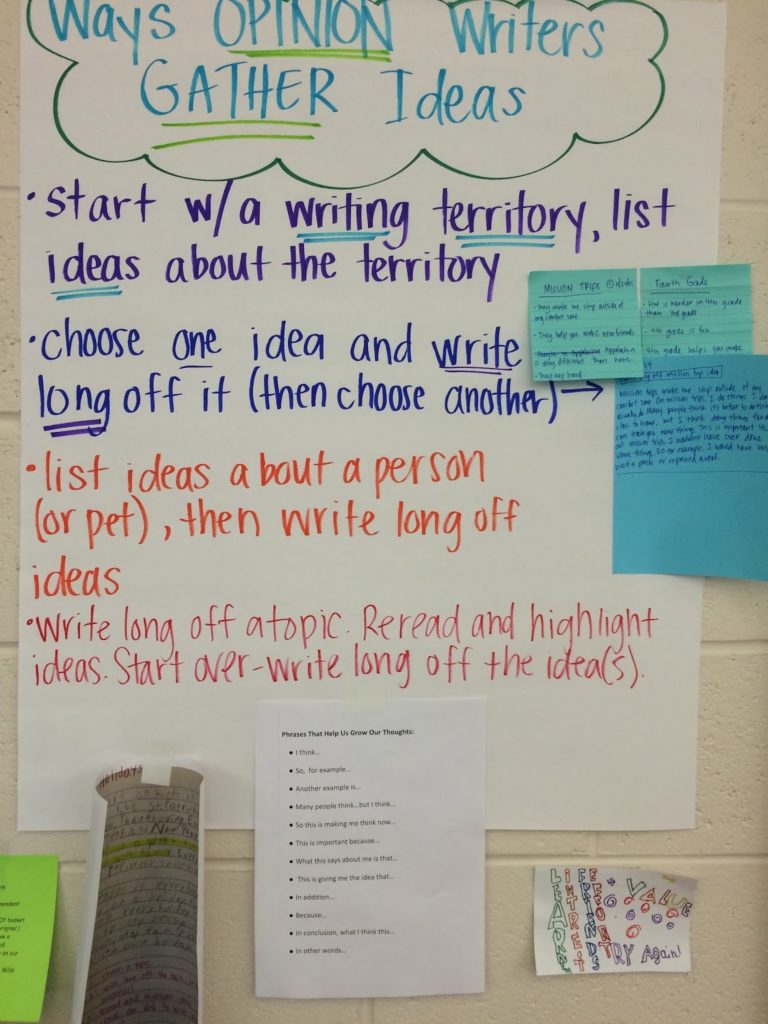
We’ve all been in (or, at times, have been) the classroom that has chart paper as wallpaper. Every open space, and maybe even open window, is occupied by a chart. Looking across the charts, there seems to be no common theme. There are both nonfiction and fantasy reading charts, personal-narrative and feature-article-writing charts. The room is, literally, a record of all the teaching that has happened across the year. If you ask the students to show you the charts that reflect the work they’re currently doing, they look at you with a blank stare or look from one chart to the other, not sure where the charts they need are.
We’ve worked to grow to see charts as tools and teachers rather than as a record of the teaching we’ve done. That might seem like a subtle shift, but we think it’s an important one. It moves charts to being for the learners in our room rather than for the teachers in the room. Some ways that we’ve made this shift are to co-author the charts with or in front of our students, make them interactive, and make them accessible.
Co-Author Charts
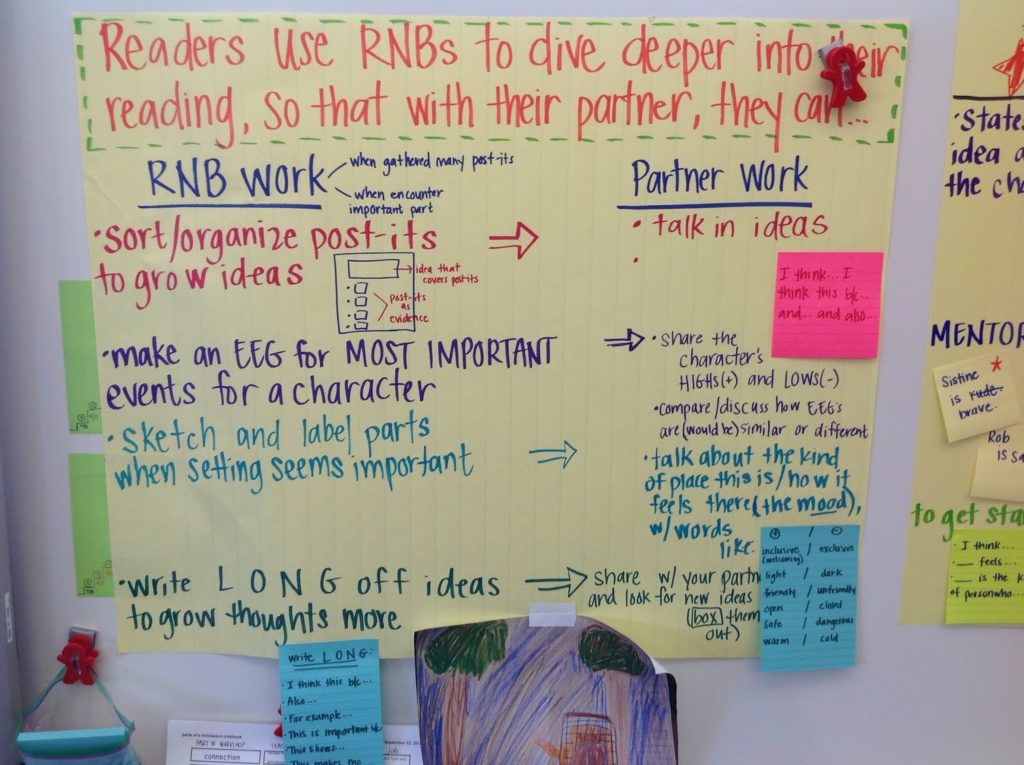
Although we might make the bones of a chart before a minilesson, we do most of the writing on it in front of the students and refer to it throughout the minilesson. Similarly, our charts grow and change across a unit. The chart below, for example, would likely be introduced with the title (in orange) and the two columns (in blue) already on it. Then, across the days and weeks of the unit, we add the bullet points to the chart, usually pausing during the teaching point of the minilesson.

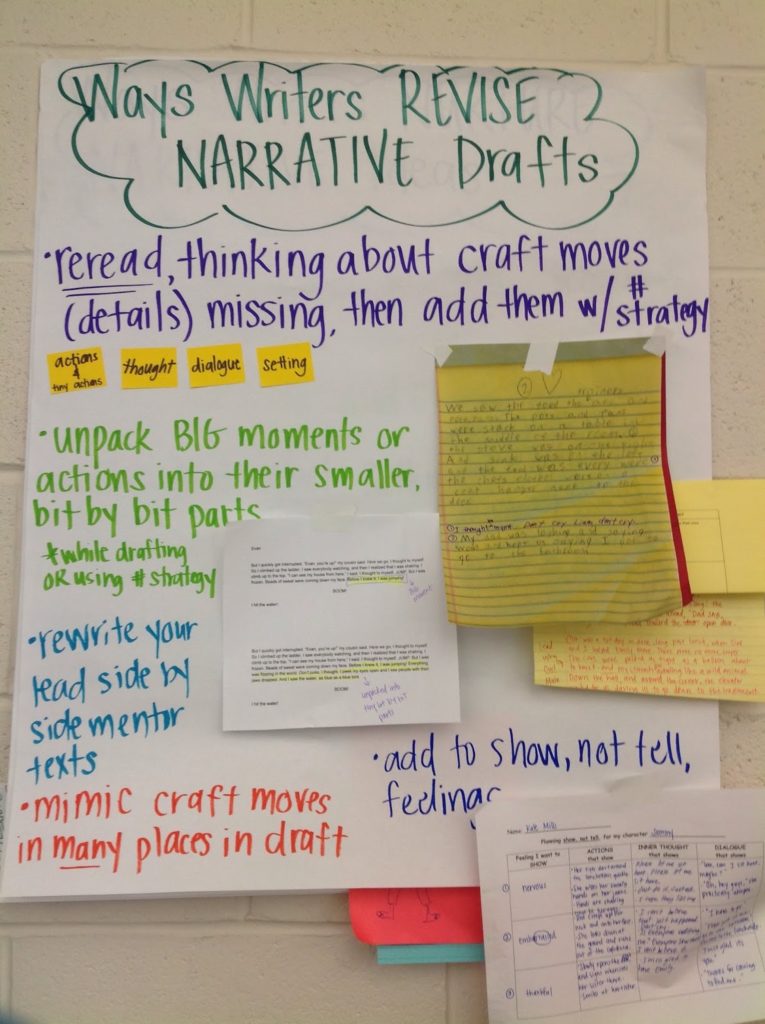
Another way we co-author the charts with our students is to add the examples used during the minilesson. These shared examples help to remind and to reinforce the learning that was done. On the chart above, the blue and pink sticky notes show work that was done during the minilessons, during either the teaching or the active engagement (or, often, both) and then added to the chart at the end. The chart below also has examples used during the minilesson, but most of them are examples of student work that was used during the teaching part of the lesson.
These are the yellow notebook pages and the white computer-printed pages on which we highlighted the parts focused on.

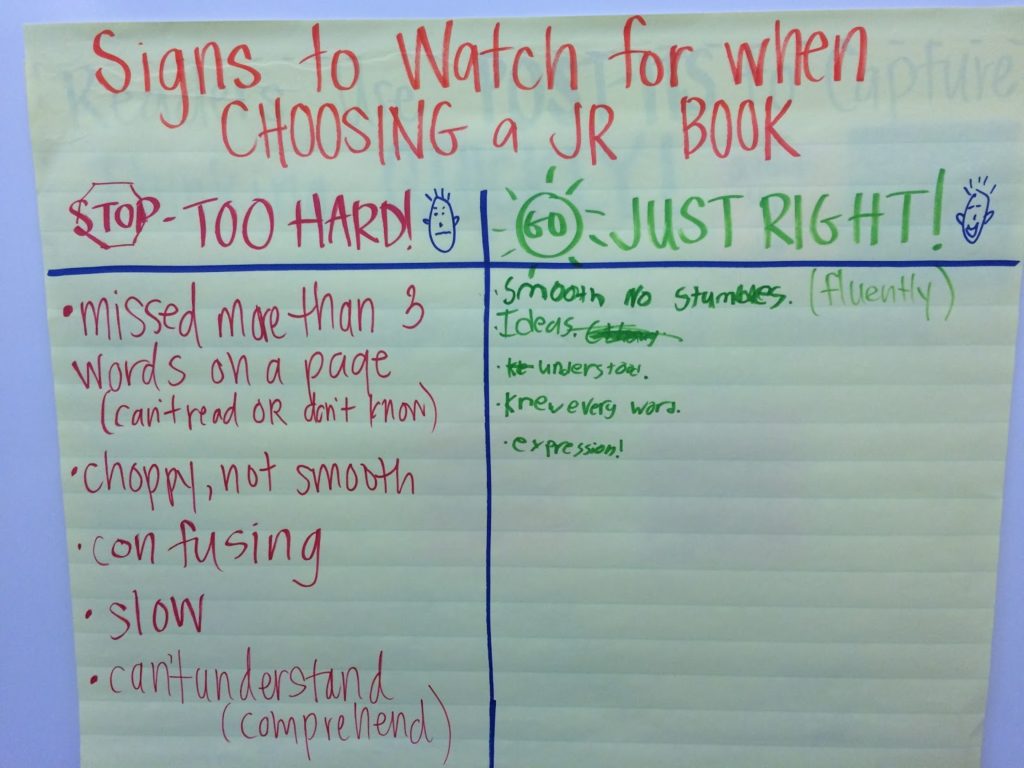
We will also sometimes have the students actually write things on the chart during the minilesson, which is maybe co-authoring in a truer sense, as they did with the green column in the chart below.

Although we’ve definitely thought through the language we’ll use and how the chart might end up looking at the end (charts are one thing we plan when preparing a unit of study), we believe that creating the charts in front of the students is essential if we’re going to expect them to know what’s on the charts and, even more important, use the charts independently.
Make Charts Interactive
Charts in our room almost always have lots of different sticky notes on them. The sticky notes might show steps in a strategy or work that illustrates the strategy being used. We also use sticky-note tape to make anything able to stick to the chart.
The purpose of using sticky notes and sticky-note tape is for students to be able to remove those items and use them as tools where they’re working. We make sure to show students how they can borrow them and return them when they’re finished. We spotlight and celebrate when students are beginning to do this so that it catches on across the class. That way, the chart is being returned to again and again and students know it is a tool that has been made for them.
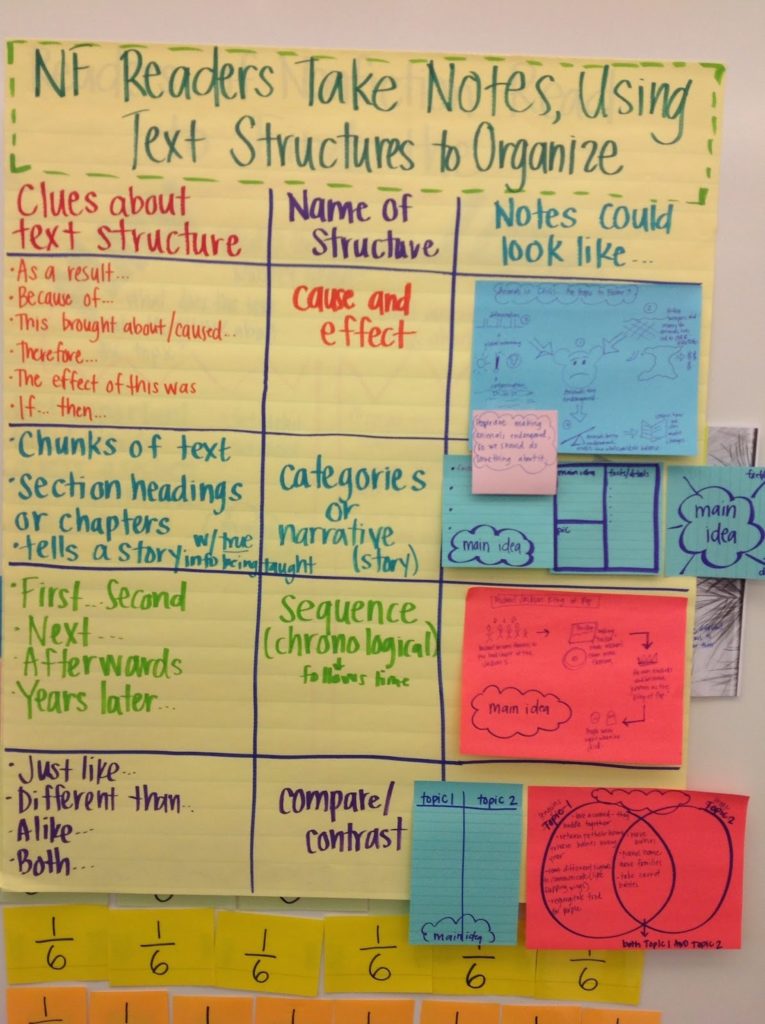
In the chart below, the third column has sticky notes that show how students might structure their nonfiction notes. Some of the sticky notes are just reminders of how the structure might look, whereas others show the structure with actual notes taken as a class during the minilesson or read-aloud. Students can remove the sticky notes to support them as they take notes on their reading.

In the chart below, there are parts that can be removed that include work done collaboratively during the minilesson, work shown as a model during a minilesson, and phrases to support students in their writing.

Make Charts Accessible
Because almost all of our charts are interactive, it’s important that students know where they are and that they’re able to reach them.
The first step we’ve taken to help our charts be more accessible to our students is to color-code them. We mostly use the large sticky-note chart paper, and use the yellow lined chart paper for reading charts and the white chart paper for writing charts. That way, students can narrow down which chart will support their work just by looking at its color.We’ve also grouped our reading charts together and our writing charts together, and put a star sticky note in the corner of the writing chart that shows the part of the process we’re currently on. For example, across a narrative unit we’ll have a different chart for each part of the process, and these charts will remain accessible for the duration of the unit since our students might be at different parts of the writing process. If our minilessons are focusing on revision strategies, though, the star sticky note will be on the revision chart. We also have a part of the room dedicated to math charts and science or social studies charts.
Once we’ve moved on from a unit, we take the charts down. Sometimes we throw a chart away, and other times we tuck it away in a closet. (If we just finished our first nonfiction unit, we’ll likely use those charts later, and narrative charts for writing can be used across personal narrative, fiction, and fantasy units.) Before we take the chart down, we always take a photo of it and upload it to a shared folder organized by subjects that our students can access. We make a link on the homepage of our class iPads. The photo below shows what the page looks like when students open the link to our reading charts.

We tend to take a photo and catalog the charts at the end of the unit, since the chart is more finalized by then, but because our fourth graders are comfortable using iPads, it’s not uncommon for them to take photos of the chart before it’s been uploaded to the shared folder so that they’re able to see something more easily as they work. (And we, of course, celebrate and do a dance inside about their resourcefulness.)
We know that the way charts are structured will differ across grades or student populations (for example, there may be more visuals and less print for young children), but we think that when charts are co-authored, interactive, and accessible, it helps them be used more as tools and as teachers across grade levels and student populations.
Sunday, October 15, 2023
Monday Motivator #8 2023-24
What to say when a student tattles: 3 Responses
https://www.youtube.com/watch?v=jx8j1oSBqcs
When a student swears - this video is from a parenting coach but could apply to the classroom setting as well:
https://www.youtube.com/watch?v=pnH2vmvc5hw
Sunday, October 8, 2023
Monday Motivator #7 2023-24
Raising Student Voices: Mentor Texts
I’ve never really gotten over watching A Muslim and Jewish Girl’s Bold Poetry Slam on YouTube. Amina Iro and Hannah Halpern share their poem about the way the world sees them. They help us see the way we are all more alike than different. I remember thinking about how powerful their message was the first time I watched it. I couldn’t help but wonder: What had to be in place for these two during their school years for them to learn to raise their voices like this.
Certainly to write a poem like this, these two young poets had to have considerable opportunities to write for purposes that were important to them. Listening to the craft of the lines they wrote, the way the two voices danced together and then drifted apart, hearing the words carefully chosen, one can’t help but see the layers of teaching and experience that have gone into making this moment. Certainly many writing opportunities and a lot of work helped these two poets get to this place in their writing lives.
This poem, although beautifully crafted, is about much more than ways with words. It illustrates the power in words when children are taught to raise their voices, when they learn that their words matter. Although the poem was first shared nearly six years ago, there has been little change in our world that tries to fit people into boxes, often choosing to hear one story over the complexity of the many that make each of us who we are. Even if we reach back into the history of our world, we will find that we have always been unable to shake the stereotypes and really look deeper into the complexity of the stories. In Being the Change, Sara K. Ahmed points out, “What I have learned is that we cannot progress as a society if we rely on television images, single stories, and sensationalized headlines over getting proximate to the personal experiences and individual truths of human beings who don’t look like us.”
Many experiences and conversations go into getting our young writers to this place. Perhaps we can help students learn to raise their voices like Amina and Hannah simply by thinking about reading and writing. First of all, it seems, children have to know their stories are welcome in our classrooms. We spend time building safe writing communities where children feel comfortable taking risks, where they know their peers will listen to their stories.
In addition to opportunities to write stories, many books can help students learn to raise their voices. Here are a few to begin:
For Our Youngest Learners
Come with Me by Holly M. McGhee and illustrated by Pascal LemaƮtre
A small girl is frightened by all she sees on the news and in the world. Her father helps her see that sometimes we begin by just taking a step and then finding someone to take a step with us. This book helps readers see how being our best selves can be one positive way to raise our voice.
Say Something! by Peter H. Reynolds
The author encourages readers to take action when they notice something that needs to be changed. The book reminds readers to trust their voice and find a way to say something.
One by Kathryn Otoshi
It takes a lot of courage to stand up for others. In this story, Blue is always being picked on by Red. Although other friends see what is happening, no one is brave enough to stand up to Red until One comes along. This book reminds us about the importance of speaking up and raising our voice for others.
How to Change the World (a work in progress) with Kid President by Soul Pancake
In this video, Kid President shares ways we can begin to work toward change. This could easily work as a mentor for growing discussions about how we can work toward change in our classroom, school, community, and world.
As They Grow
She Persisted Around the World by Chelsea Clinton and illustrated by Alexandra Boiger
The world is full of challenges and hurdles to overcome. Chelsea Clinton shares the stories of girls around the world who raised their voices and broke through barriers.
Malala: A Brave Girl from Pakistan/Iqbal: A Brave Boy from Pakistan by Jeanette Winter
Two children from Pakistan raise their voices against the fact that some children have to work or are unable to get an education. This picture book has the story of Iqbal on one side and the story of Malala when the book is flipped.
Let the Children March by Monica Clark-Robinson and illustrated by Frank Morrison
This beautifully illustrated book tells the story about how the children of Birmingham, Alabama, raised their voices and marched to fight for their right to freedoms afforded to others.
Reuben Paul: What This Third Grader Has Accomplished Will Blow Your Mind. This news clip shares the story of Reuben Paul, who wanted to raise his voice to help others stay safe in today’s cyberworld.
Older Learners
Little Leaders: Bold Women in Black History by Vashti Harrison
This book is full of stories of Black women who raised their voices to create change.
Rhythm and Resistance: Teaching Poetry for Social Justice edited by Linda Christensen and Dyan Watson
This publication from Rethinking Schools is full of poetry written to illustrate the many ways poets can raise their voices. Not only is the book full of poems that can be useful across grade levels, but there are suggestions for lifting student voices through poetry.
Mari Copeny: Mari Copeny has stood up against the Flint water crisis since she was eight years old. The social page of her website shares the way she uses social media to amplify her voice and raise awareness about the crisis.
When the news gets the better of me and the world makes me shake my head, I look out at the young learners gathered together in one community. I listen to them talk to one another, share their stories, and work to make sense of the world, and I know we need their voices. My job is to help them realize they have a voice today—and certainly tomorrow. The picture books, poems, and digital compositions shared above might be a starting place for helping our students know the power in their words. Their communities need to understand their stories. The world needs each one of their stories.
Helping students learn to raise their voices begins in the safe space of our classrooms. It begins in quiet conversations, in our community circles as we talk together, in the willingness to open the floor to everyone’s story. In The Day You Begin written by Jacqueline Woodson and illustrated by Rafael López (yes, another one to add to your list), we are reminded, “There will be times when you walk into a room and no one there is quite like you until the day you begin to share your stores. All at once, in the room where no one else is quite like you, the world opens itself up a little wider to make some space for you.”
Sunday, October 1, 2023
Monday Motivator #6 2023-24
Commitment Contacts
From the Panorama Playbook: https://playbook.panoramaed.com/moves/1577
Details:
The "Commitment Contacts" activity aims to foster student agency by having students create contracts that outline their personal goals, challenges, and tasks they wish to master during the school year.
Goals:
The goals of this strategy include:
- To encourage student ownership and self-directed learning by setting and committing to individual goals.
- To build trust and community within the classroom through mutual agreements between students and educators.
Action
Commitment Contracts
serve as a mutual agreement between the educator and the student, emphasizing the importance of community support and ongoing reflection.
Preparation
- Materials Needed: blank sheets of paper for contracts; writing utensils
- Prepare to facilitate a discussion that helps students identify their goals, challenges, and tasks they want to focus on.
Instructions
(1) Explain the concept of a commitment contract and its purpose in fostering student agency and self-directed learning.
(2) Engage the class in a discussion to identify individual goals, challenges, and tasks they wish to focus on during the school year.
(3) Provide students with blank sheets of paper and ask them to draft their commitment contracts. These should include their goals and the steps they plan to take to achieve them.
(4) Once the contracts are drafted, review them together with each student and make any necessary adjustments. Both the educator and the student should sign the contract.
(5) Pair students with a commitment buddy
who they will check in with regularly to discuss progress and challenges.
(6) Set aside time at regular intervals for students to review their contracts and discuss them either individually with the educator or as a class activity.
Implementation Tips
- Treat the contracts as
living documents
that can be revisited and revised throughout the school year. - Use the contracts as a basis for classroom discussions, especially when issues arise that relate to the commitments made, to foster a solutions-oriented approach.
Why this works
Research indicates the importance of mutual agreements and self-regulated learning strategies in promoting student agency and achievement.
Supporting Research
Zimmerman, B. J. (2002). Becoming a Self-Regulated Learner: An Overview.
Theory Into Practice, 41(2), 64–70.
Sunday, September 24, 2023
Monday Motivator #5 2023-24
Transforming the Way Students See Themselves
By Mari Jones
“I hate my life.” Valeria had written these words on her art journal when tasked with designing the cover. This reflected her perception of school, her life, and herself when she entered my class two years ago. Truth be told, her life was hard. She had been living in a homeless shelter in second grade when she came to High Tech Elementary Explorer, a project-based, social-emotional charter school in San Diego. When she came to my class in fourth grade, she and her family had found a home, but she still had to take two buses and a trolley to get to school, and she struggled with depression and a learning disability. She was always sleepy, and never wanted to participate in the learning in our classroom. She often lay her head on the table saying, “I can’t do it.” She did not see herself as a learner. I knew that my work lay in helping her rewrite the narrative she had written for herself.
My interventions for Valeria came in the form of supports for her academic, as well as social-emotional, development. Mostly, I wanted to change her negative self-talk, and convince her that she was a learner whose work mattered to others. Regular exhibitions throughout the year gave Valeria the opportunity to share her learning with a larger audience of peers, family, and the community. Knowing she would publicly present her work provided the motivation to produce high quality work. Continuous reflection throughout the process allowed her to notice the ways in which she was growing as a learner and as a person. One of her artist statements revealed the beginnings of her transformation, “I think I have grown as an artist, because I know how to handle more responsibility.” In doing work that mattered, Valeria was beginning to see that she mattered too.
As Valeria’s negative self-talk began to subside, it was replaced by an enthusiasm for presenting her work to the public. For our Ideas that Change the World project, we had the opportunity to present our work as an exhibit at the San Diego History Center. They were commemorating the centennial of the World’s Fair in San Diego, and our World’s Fair exhibition fit in seamlessly. I could see Valeria’s growing confidence as she presented her invention to retirees visiting the center. Her invention, the R-Cart, was a robotic shopping cart that would aid blind shoppers. She fielded questions, demonstrated how it worked, and explained the invention process to her audience. “I wish I could have one now!” commented a guest. A far cry from the sullen girl who lay her head on the table, Valeria was bubbly and energetic, smiling and almost dancing as she shared her work.
Fast forward to the end of the year at her fifth grade presentation of learning. Valeria is standing confidently in front of a panel of her peers, family, and teacher, sharing her growth as a learner. She talks about the American Dream project, which she is most proud of, because it allowed her to face her fears and stand up in front of a live audience at the World Beat Center in Balboa Park, and perform her original spoken word poetry. She goes on to say that reading and writing have been challenging for her, but that she has been able to complete her work this year. As I look over at her mother and sister, I can see the pride in their eyes–they can tell that Valeria sees herself as a learner.
When students have the chance to do work that matters, and to present that work to people who matter to them, it makes students believe that they matter. Valeria did not transform overnight. But her story is the story of many of our kids, who need us to see them. Exhibiting her work to a real audience and sharing her reflections on her growth as a learner throughout the year allowed Valeria to shine.
https://www.edweek.org/education/opinion-transforming-the-way-students-see-themselves/2017/08
https://www.gettingsmart.com/2017/12/16/transforming-the-way-students-see-themselves/
Sunday, September 17, 2023
Monday Motivator #4 2023-24
How To Respond To A Sudden Increase In Misbehavior
Once in a great while, especially in the first few weeks of the school year, your students may test you to see if you really, really do mean what you say.
Or sometimes there is bad luck involved . . .
A fire drill.
Arrival of new students.
Wi-Fi outage.
Hard rain against the windows.
Anything unexpected can stir up excitability and incite an increase misbehavior. And you can’t run away scared. No matter what, you still must follow through calmly.
Fulfilling your promises will go a long way toward limiting any surprise disruption and getting back to work. The worst thing you can do is show frustration, lecture your class, or bypass your classroom management plan.
Still, your class—or a portion of your class—may have showed a lack of maturity. Maybe they spontaneously ran to the windows or they started yelling and getting out of their seats in reaction to the fire alarm.
Even if it’s a momentary disruption, you can’t just let it go. Not only do you want to avoid something similar from happening again, but it’s an opportunity to get better.
So what follows are three steps that do just that.
1. Review
Review what happened like a small town newspaper reporter. Don’t mention any names. Just stick to the facts and recap in detail, leaving nothing out.
It’s most critical that you don’t show displeasure. You can even be matter of fact. Modeling is okay too. The key to this step is for students to see what happened objectively and through your eyes.
2. State
Step two is to simply state that such behavior isn’t okay and will never be accepted. Even though you’ve already taught your classroom management plan, and have followed through consistently, they need to hear you say it.
Then pause. Let your words hang in the air. Though you won’t show irritation or annoyance, your class must see your seriousness and commitment to high standards.
3. Practice
Now have your class show you how they should have behaved. Depending on your grade level, you may have to first model what you expect.
Give your ‘go’ signal and allow 30 seconds to a minute of correct, mature behavior. Yes, it may just be sitting in their seats quietly. It may be lining up to leave the classroom. No matter, let them prove they understand.
Good News
In most cases, the three steps should take about five minutes. But even if it takes longer, it’s worth it.
Again, it’s an opportunity to push the maturity envelop. It raises the bar on overall classroom behavior and personal discipline. You can even view bad moments and sudden increases in misbehavior as good news.
It’s important to mention, however, that it’s best not to complete the three steps right away. Allow for at least a couple of hours. The next day is often best.
This allows students to view the situation and their role in it with a calm heart and fresh set of eyes.
After step three, praise them for doing it right and then move on to the next lesson or activity as if nothing happened. It’s fixed and the burden has now shifted in total to your students to handle similar situations better the next time.
And they will.
https://smartclassroommanagement.com/2023/09/14/how-to-respond-to-a-sudden-increase-in-misbehavior/
Monday Motivator #34 2025-26
How Teachers Can Benefit From End-of-Year Reflections A teacher mentor shows why reflecting at the end of the year is so important for gro...
-
Charts at Tools, Charts as Teachers We’ve all been in (or, at times, have been) the classroom that has chart paper as wallpaper. Every ope...
-
10 Ways to Sabotage Your Classroom Management by MiddleWeb · Updated 08/03/2024 https://www.middleweb.com/19037/10-ways-sabotage-clas...
-
8 Small But Impactful Classroom Management Shifts How using subtle gestures, spatial awareness, and tone of voice can nudge your classroom...