Sunday, April 26, 2026

Monday Motivator #32 2024-25

Responding to Dysregulated Behaviors: What About the Other Kids?

https://choiceliteracy.com/article/responding-to-dysregulated-behaviors-what-about-the-other-kids/

A new student had entered our world and really shaken things up. I had to adjust our expectations for a chunk of time so that our newest friend, Nolan, could adjust to our world. 
It was an incredible experience as a teacher to step back and watch students step in and support Nolan in ways they were capable of because of the work we had already done together. 

Tucker

In a moment when Nolan was beginning to feel dysregulated, Tucker did what I had done countless times this year to ground the children in our schedule. Tucker guided Nolan over to our visual schedule and used it as a tool to co-regulate with Nolan.

Thinking through what led to Tucker being this literacy leader, watching him was a little surreal. As I watched Tucker take care of Nolan, I saw how far we’ve come. Tucker knew that the visual schedule helped his own brain, so it would probably help Nolan’s brain too. Tucker had watched me point under each word of everything we read even before the kids knew what words were, so he did it for Nolan too. While Tucker was just modeling what he had seen me do for 100 days, he was doing exactly what Nolan needed. 

Beyond scaffolding Nolan’s early literacy skills, Tucker was modeling what self-regulation looked like. He was providing Nolan with coping strategies that would carry him through his worry and help him know what was coming. There is comfort in that, knowing what is coming next, and knowing that other kids are comfortable with what is to come. Nolan sat and listened to Tucker more intently than I had seen him listen to anything yet. Peer models, partners in learning—they are some of the most critical pieces to engagement in learning.

Much learning can be done independently, but it is immensely enriched when there is someone to share it with. As adults, we seek a learning partner in most things we do; it is logical, then, that kids would do the same. The old adage of “two heads are better than one” was coming to life before my eyes. When Nolan had Tucker to mirror, he found success. The mirror neurons firing back and forth, Nolan regulated and was able to open his window of tolerance a little wider. In this slight opening, Nolan’s literacy brain was growing stronger, and my opportunity to teach my small groups and confer with my readers was apparent. Nolan began to discover the wonder of books, to dig in and see what the hype was all about. 

Nova

Nova is a vibe all on her own. She has a personality that fills the room as she enters it and can control the emotional thermometer in both positive and negative ways. Nova and I have worked hard this year to use her character traits for good, to be a quiet, gentle, and strong leader. From the moment Nolan walked through our classroom door, Nova called the two of them “N buddies.” She made herself Nolan’s personal tour guide and instant friend. Nolan wasn’t totally sure how to handle this instant love from Nova, but he didn’t hate it, so I watched how it played out. 
I watched in awe as Nova showed Nolan around, where to get breakfast, where to sit for morning meeting, what to do when he was done. She was doing many things I had planned to do on my own, but the impact of this information coming from another child in the class was far more powerful. Nova was not shy about calling out inappropriate behaviors when Nolan would start to roll around on the rug or threw a book across the room. I would hear her say, “Nolan, books are treasures; we treat them that way,” as I navigated the situation with Nolan and maintained safety.

I wondered if Nova would pull away as time passed and Nolan exhibited some trickier behaviors that even I was trying to figure out how to handle. Instead I watched as Nova leaned in harder. She embodied the idea that it is never too late to turn a day around, and she gave Nolan every chance to try again. Nova greeted Nolan with the same love and respect she greeted everyone else with. She also held him to the same standard and expectations she held everyone else to. 

A few weeks into watching this relationship build, I realized I was watching Nova do precisely what I had done with her at the start of school, but on an even bigger scale. Nova came to kindergarten with harsh interactions and big opinions leading the way, and it made life in our class tricky for a time. With patience and intentional coaching and instruction, Nova learned the skills to regulate herself to interact appropriately with others. She could now help friends if they wanted help but also give them space if they wanted to keep trying on their own. Nova could wait to share her thoughts and was okay not being first in line. Nova knew the importance of listening to others’ thinking and trying out her friends’ ideas because they can come up with really great ideas too.

Nova was able to immediately identify that Nolan needed similar supports, and likely without thinking, she provided those peer supports for him. It is just a part of who she is now. In becoming this buddy to Nolan, Nova was lifting the level of the work she was doing throughout her day. She was thinking of someone else before herself and learning to navigate the world in a new way so that she could best support her new friend who needed things to be a little different. Nova and Nolan ended kindergarten still good friends with intricate, fun games they played together at recess and deals to sit together at the quiet table at lunch.

Many More

I could go on to tell you about the other kids in the class and how their interactions with Nolan were beautifully wholesome and growth-oriented for all involved. The fact of the matter is, Nolan came in and exposed the other children to some really intense, and sometimes unsafe, situations. Many adults’ first response upon hearing about these situations was “That’s not fair to the other kids.” 

I am often left unsure of what to say in those moments. It is true that the other kids did not choose to be in a class with a child who feels so dysregulated, he acts out in major ways. But also, I think they are better humans because they are in that class. Nolan didn’t choose to present his dysregulation in that way. What a gift for him to be in a class full of other kids ready to come alongside and love him as he learns new ways to cope and regulate. What a blessing for the other kids to be able to use their skills on a new level and model coping and regulation skills for him. And what an honor it is to be their teacher and get to come alongside all of them, do the hard things together, and be better humans in the end. 

Sunday, April 19, 2026

Monday Motivator #31 2025-26


Address Student Anxiety to Boost Their Learning

By Gravity Goldberg
https://www.middleweb.com/52328/address-student-anxiety-to-boost-their-learning/

Seventy percent of teens say anxiety is a major problem in their peer communities. Approximately two thirds of American children will experience at least one traumatic event by the time they are sixteen. At least sixty percent of students have been impacted by Adverse Childhood Experiences (ACEs) which have been shown to create chronic stress.

This means that all of us teachers have students in the classroom that may be experiencing dysregulation of their emotions. As teachers we can focus more on anxiety and students’ need for safety. When we bring this lens into classrooms, we notice nuances and can help students experience the regulation they need for any learning to happen.

Students who are anxious may look like this:

  • Avoiding
  • Daydreaming and staring off
  • Fidgeting and leg bouncing
  • Shrugging of shoulders
  • Not knowing where or how to start
  • Losing materials and being disorganized
  • Asking for clarification
  • Needing reassurance
  • Head down on the desk
  • Getting up and moving around

Many of us may have mistaken student behaviors as signs of misbehavior instead of dysregulation. If we see a student with their head down while we’re talking, we may even interpret it as a sign of disrespect.

A students’ body language is a window into their nervous system response
 and not necessarily a reflection of their feelings toward us or our subject. When we bring this perspective into the classroom, it helps us view behaviors as information we can use to better understand our students and how they are doing.

Dr. Stephen Porges developed polyvagal theory which explains how safety is experienced in bodies. Our bodies are built to perceive our environments and form conclusions about them. We do this through a process called neuroception. Neuroception is not just a visual and thinking based conscious process. It includes visceral feelings as well as environmental cues.

Based on our process of neuroception, our bodies make conclusions that may trigger us into fight, flight or freeze mode if a potential threat is discovered. The process of neuroception is an unconscious process that happens beneath the level of awareness. Our bodies do this to keep us safe without the need to direct our attention to the process.

When students are asked to pick up a text and begin reading, we teachers may not assess any threats but that does not mean students are having the same neuroception experience as us. In fact, what seems totally safe to us might feel quite threatening to them, such as reading a complex text, being asked to share out loud in front of peers, or being partnered with someone they don’t know.

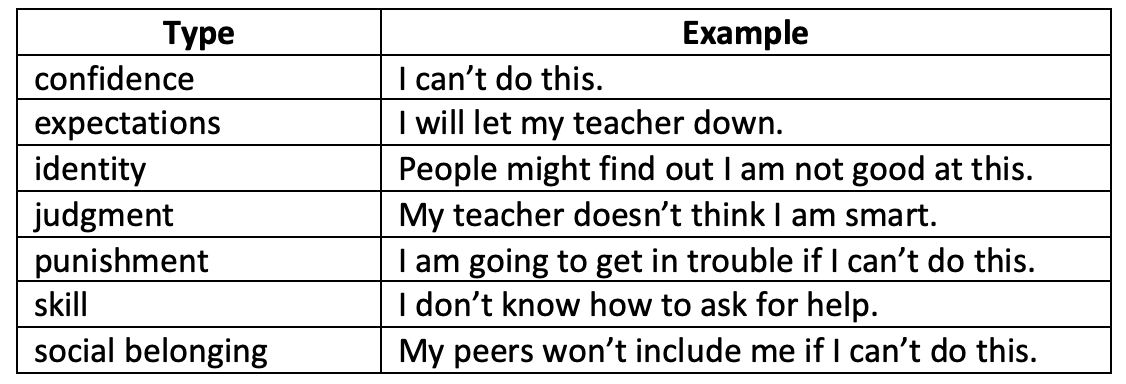
Types of Threats Students May Experience

To complicate matters, what looks like task avoidance and attention issues might be a nervous system response students have little control over. At the core of all of these fears is the fear of disconnection and of not belonging.

Teach kids about the autonomic nervous system

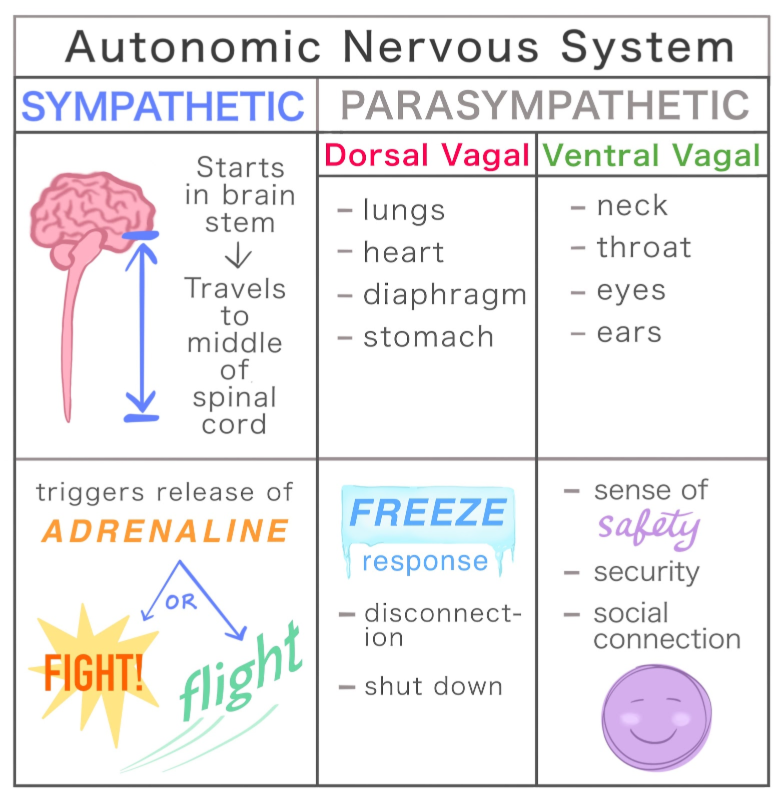
The autonomic nervous system is a two branch system in our bodies that helps us survive. The two branches include the sympathetic and parasympathetic responses that travel down three possible pathways. The sympathetic branch starts in the brain stem and travels to the middle part of the spinal cord. This pathway prepares our body for action by triggering the release of adrenaline that can send us into fight or flight.

The parasympathetic branch
, which is connected to the vagus nerve, has two possible pathways. The vagus nerve begins in the brain stem at the base of the skull and travels in two directions – downward through the lungs, heart, diaphragm and stomach, and upward to connect with nerves in the neck, throat, eyes, and ears. How a student perceives their environment triggers this nervous system response and impacts how and if they will be able to learn in the classroom.

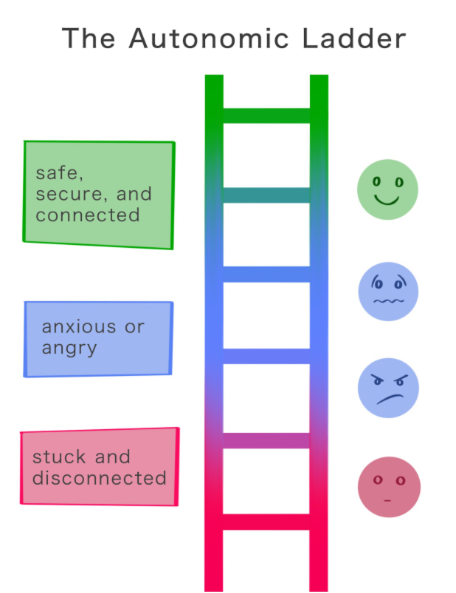
A ladder visual can be helpful to use when teaching students about how their autonomic nervous system works. Show them an image like the one that follows. Explain that it is totally normal, and part of being a human in community, to move along this ladder across the day.

You can periodically pause and offer space for students to check in with themselves using the ladder. They might use words or emojis or both. Unless students volunteer to share where they are, there is no need to ask them to make this check-in public.

If students (or any of us for that matter) spend too much time in the blue anxious or angry rung, we eventually get so overwhelmed that we move further down into the stuck and disconnected red rungs. When this happens, our brains are not open to teaching or able to access the information being shared.

That glazed over or numbed out feeling means we need to reset our nervous system before we can re-engage with the lesson. This feeling of being stuck may look like this:

  • Ruminating on the past
  • Worrying about the future
  • Second-guessing
  • Staring off into space
  • Asking for clarification right after your teaching
  • Shrugging shoulders as responses
  • Wanting adult approval for every step of their work
  • Waiting for an adult to get started

In order to help students experience more regulation and handle the threats they perceive, try the following practices.

Notice and Feel:
 Teach students how to recognize the signs in their own bodies that they are moving down the ladder. Offer space to pause and feel what the sensations are like so they can recognize them as they appear. It is likely different for each student.

Take a Brief Break:
 Let students know it is okay to take a break when they are recognizing the signs of fight, flight or freeze (the lower rungs on the ladder). If they can notice the cues before they get fully engulfed by the feelings, they may be able to pause on a rung and not travel any further. This brief break may be a time to get up and go for a walk or take a sip of water, a time to close their eyes and take some slow breaths, or a time to move to a “peace corner” set up in the room for times like this.

Ground:
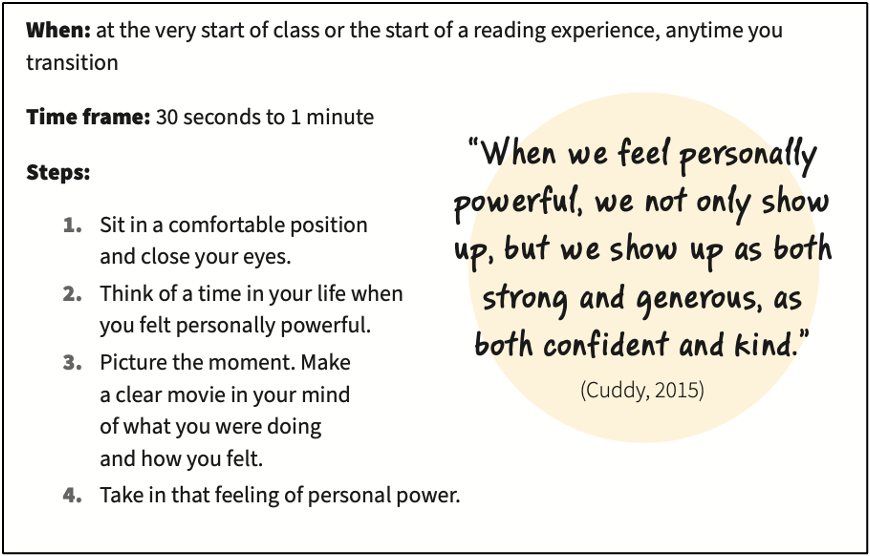
 Proactively start lessons with a brief grounding practice to help prime students’ bodies to be ready to learn and experience more regulation. Try this sample grounding experience called Visualizing Personal Power.

Teachers need to check in, too

I’ve learned over the years that if I take a few moments across the day to check in with how my body is feeling and where I am on the autonomic ladder, I get more of a sense of my students as well. When I am feeling anxious, it is very likely that my students are too. I benefit from all of the same practices recommended for students.

While our bodies are connected to all of the learning happening in the classroom – through movement, social inferences, memory, executive functioning, gestures and so much more – the most important aspect to consider first is “Do my students feel safe right now?” If we ask this question first, before we even name the lesson objective or explain the success criteria, we are opening the path to an effective and human-centered learning environment where more students can be ready to learn.


Gravity Goldberg is an educational consultant and author of ten books on teaching including her latest release The Body-Brain Connection: Evidence-Based Ways To Reduce Anxiety, Boost Engagement, and Increase Comprehension In the Classroom (Corwin, 2025). During her 25 years of teaching she has served as a science teacher, reading specialist, third grade teacher, special educator, literacy coach, staff developer, assistant professor and yoga teacher.

Sunday, April 12, 2026

Monday Motivator #30 2025-26

 Strategies for De-escalating Student Behavior in the Classroom

Full Practice Brief can be found here.


https://www.pbis.org/resource/strategies-for-de-escalating-student-behavior-in-the-classroom


Monday Motivator #34 2025-26

  How Teachers Can Benefit From End-of-Year Reflections A teacher mentor shows why reflecting at the end of the year is so important for gro...