Sunday, May 12, 2024

Monday Motivator #35 2023-24


There's still time to make a big impact on your students! Finishing the school year strongly helps to ensure that students have learned and retained the necessary material, and that they are prepared for the next school year. You can make sure your students are prepared by reviewing key concepts and skills from the current school year, providing end of the year activities for students to practice and reinforce their learning, and encouraging them to continue exploring and learning over the summer.
5 End of Year Tips For Finishing Strong

From creating a positive classroom environment to setting achievable end of year SMART goals, keeping students engaged and motivated, celebrating achievements, and planning fun end of year activities this list has got you covered. 


Let's dive in and explore some effective and easy ways to ensure that you don't let the school year fizzle out, but instead finish it strong and set your students up for success!


1. Stay positive and enthusiastic.

As the end of the school year approaches, it's natural for both teachers and students to start feeling a sense of exhaustion and burnout. Your attitude can have a big impact on your students. 


Stay positive and enthusiastic, even as the school year winds down. This will help to keep your students motivated and excited about learning. Try these year end activities:


  • Gratitude journaling: Encourage students to write down three things they're grateful for each day. This can help them focus on the positive aspects of their lives and build a sense of optimism.

  • Acts of kindness: Have students participate in random acts of kindness, such as writing a note of encouragement to a classmate or helping a teacher with a task. This can help students focus on the positive impact they can have on others and build a sense of empathy and compassion.

  • Positivity Posters: Have students write compliments on each others’ posters. Something the student is good at, something you like about their personality, or something that makes them fun, special and one-of-a-kind! This activity gives kids a self-esteem boost while reminding them of how great it feels to be kind and compliment others. (Included in resource below!)

Kindness Activities & Quotes Elementary Resource


2. Set goals for the end of the year.

Setting goals with your elementary students for what they want to achieve before the end of the school year will help to keep them focused AND give them a sense of purpose.


These SMART goals can help students stay motivated and focused, and give them a sense of accomplishment as they complete their final assignments and assessments.


  • Reflection Journaling: Encourage students to reflect on their progress so far in the school year, including their strengths and weaknesses. Then, ask them to set specific goals for the remainder of the year based on their reflections.

  • SMART Goals: Provide students with a SMART goals activity that helps them set specific, measurable, attainable, relevant, and time-bound goals. This goal setting activity helps students break down their goals into manageable steps and measure their progress along the way.

SMART Goal Setting for End of the Year & Summer Mini-Unit

3. Keep students engaged.

At the end of the year, students can become restless and disengaged, making it difficult to maintain focus and productivity in the classroom. However, by implementing a variety of engaging year end activities, teachers can keep your elementary students motivated and excited about learning until the very end.


  • F-U-N! Incorporate fun and creative activities into daily lessons, such as educational games, group projects, and hands-on experiments and include team-building into lessons. These end of year activities can include collaborative projects, games, or challenges that require students to work together and support one another.

  • Student Choice: Provide students with a sense of autonomy and choice. By allowing students to make decisions about their learning, such as choosing their own research topics or selecting from a list of possible assignments, they will feel more invested in their education and more likely to stay engaged.

  • "Teach the Teacher" Day: Have each student prepare a lesson about a topic they know a lot about to teach you and your class. It doesn’t have to be academic--any hobby, interest, or skill will work. Let them create a basic outline of what they are going to teach, what supplies they might need, and how they are going to teach it.


4. Celebrate achievements.

Take time to celebrate the achievements of your students, no matter how big or small. Celebrating their accomplishments will help to build their confidence and encourage them to continue striving for success. It is a fun way to wrap up the school year and give students a sense of closure.


  • End-of-Year Showcase: Host an end-of-year showcase where students can display their best work from the year. This can include artwork, writing samples, or science projects.

  • Awards Ceremony: Create personalized awards for each student in your class, such as "Best Attitude" or "Most Creative Thinker." Present the awards in a ceremony where students can feel recognized and appreciated.

  • Memory Book: Have students create a memory book to reflect on their accomplishments and memories from the school year. They can include photos, writing prompts, and illustrations.

End of Year Memory Books for Elementary Students


5. Make time for end of year fun!

While it's important to keep your students learning, it's also important to make time for fun. Plan engaging and enjoyable end of year activities that will help your students to relax and have fun while still learning.


  • Class Projects: Try making a class book or video.

  • Themed scavenger hunts: Create clue to find around the school or in the classroom.


End of Year Elementary Classroom Craft

Finishing Strong

By staying positive and enthusiastic, setting achievable year end goals, keeping students engaged, celebrating their achievements, and making time for fun activities, you can help your students power through to the end of the school year with energy and enthusiasm.


With the tips and engaging activities, you can create a positive and memorable end to the school year that will leave a lasting impact on your students.


Let's finish the school year strong and set our students up for success!


Lastly, we also want to take a quick minute to give YOU a shoutout for all of your hard work and dedication this school year. Your commitment to education is truly appreciated! 

So here's to a successful end of the year and a well-deserved summer break!

Sunday, May 5, 2024

Monday Motivator #34 2023-24

Happy Staff Appreciation Week!

We know you do so much to help students feel safe and create a sense of belonging just like the brief example in this short video (click on the image to play - a log in may come up but just click the x and then it will play). Sometimes a small gesture can make a BIG difference. We don't always know the extent of our impact, but we make one every day. 


Have a wonderful week and many thanks for all you do to CHAMPION for our students!

Sunday, April 28, 2024

Monday Motivator #33 2023-24

5 Super Common End-of-Year Behavior Issues (Plus How to Address Them!)

You are not alone.


There is no tired like end-of-the-school-year teacher tired. There are so many reasons why it’s so exhausting, but the most common reason of all is the end-of-the-year student behaviors that can sometimes seem impossible to manage. From our students’ lack of focus to disregard for rules that were previously easy to enforce, student behaviors that arise during this time of the school year can make it seem like the last day of school won’t ever arrive.

But just because it’s the end of the year doesn’t mean that we should throw in the towel on managing these incessant behaviors. Take the opportunity to help students continue to practice appropriate behaviors, while still building our student-teacher relationships and relationships among students. Let’s take a look at the most common behavior issues that arise during the end of the school year and how we can manage the behaviors to end the school year on a positive note.

1. Excessive Talking

What it looks like: You’re teaching a lesson and students won’t stop talking. You’re trying all of your classroom-management strategies to no avail. Even your most quiet students are whispering to their friends sitting at their table team. 

Why it’s happening: Your students are excited and know the end of the year is near. The weather is getting warmer and students are starting to check out of an academic mindset and check into a summer-planning mindset. And to be totally honest, so are most teachers! So, why not join them?

How to respond: Let your students know you know how they’re feeling. You get that they’re excited for the upcoming end-of-the-school-year events and that summer vacation is almost here. Remind students that they still need to get work done, but there will still be opportunities to talk to their peers. Put a timer on for three minutes (or more or less) and tell students they have three minutes to talk. When they hear the timer, it’s time to focus. If they can focus on the lesson (remember to keep your lessons short, if possible), then you can make their “talk time” longer. 

Book to read: My Mouth Is a Volcano!


2. Incomplete Work

What it looks like: As you’re collecting work and grading, you notice that three-quarters of your class didn’t turn in the math assignment. You also see that Lucy and Daisy, who did turn in their assignment, have rushed through their work and have done the least possible to get a completion grade.

Why it’s happening: Students know that state and district summative testing is over and that report cards are most likely already finalized. They feel they don’t have to turn in work or even finish assignments because, to them, it’s not a part of their grade. 

How to respond: If students aren’t going to complete their work, take a look at the work you’re asking them to complete. Is it meaningful to your students? Do you even need it for a grade? If the answer is “no” to both of those questions, then don’t assign those assignments. Instead, have students complete work that will keep them engaged and give them ownership. Rather than assigning students a math worksheet to complete, have them make a game board that is based on the math skills they’ve learned. Have students create their own Reader’s Theatre that is based on a story instead of simply writing a summary on notebook paper.

Book to read: The Koala Who Could


3. Defiance

What it looks like: You’re teaching a lesson and Joey is wearing his headphones and listening to music on his Chromebook. You ask him to turn it off and remind him of class expectations, and he looks at you and says “no.” In your mind, you’re thinking a million things, and on the exterior, you’re trying to keep it cool and think of how to respond.

Why it’s happening: Even though most students are excited about the break from school, there are students who have anxiety about summer vacation approaching. For some students, school is their constant and their only routine, meaning that summer vacation might bring added stress and anxiety of the unknown. Having this anxiety could spark students to be defiant or have outbursts in class.

How to respond: QTIP! This means, Quit Taking It Personally. Student behavior is a form of communication, and a student like Joey blatantly telling you “no” is his way of communicating something else. If this happens during a lesson, don’t engage with the student in that moment. Let him listen to the music, and when your other students are working, talk to Joey in a safe space. Get to the root of the issue rather than letting anger take control. 

Book to read: That Rule Doesn’t Apply to Me!


4. Drama

What it looks like: Emma and Lola, who are usually best friends, come in from recess and immediately come to you crying. Apparently, Emma was playing with Chloe and Lola was upset because Emma is not allowed to play with anyone but her. Emma feels like Lola is too controlling and wants to have new friends.

Why it’s happening: Sometimes classmates and friends can form relationships that are like siblings, and spending too much time together can take a turn for the worse and make students blow up at each other. Everyone needs a break.

How to respond: Listen to both students individually so you can hear both of their stories and so they each feel heard. Bring the students together and have them tell each other what they told you. Mediate the conversation and bring the students to an agreement. Have them come to a decision about how they’ll move forward to finish the year on a good note.

Book to read: The Circles All Around Us


5. No Motivation

What it looks like: Students have lost interest and are not motivated to put in their best effort. They’re turning in sloppy work and almost seem lethargic. It seems like they’ve forgotten all classroom procedures and are just wild and carefree.

Why it’s happening: Students are obviously checked out. They know the end of the school year is near and they’re ready for summer. They could also be dealing with anxiety of the unknown in their home lives as summer approaches.

How to respond: Let your students know that you understand how they’re feeling. Also remind them that they still have tasks to complete and learning to do until the very last day of school. Set daily goals for your whole class and announce them at the beginning of the day. 

Book to read: Lazy Ninja

Sunday, April 21, 2024

Monday Motivator #32 2023-24


The Top 10 Scientific Benefits of Gratitude

July 2, 2021 by Matt O’Grady https://www.dralamountain.org/10-scientific-benefits-of-gratitude/


Gratitude as a state of thankfulness is not a new concept.  Most of us were taught as children to say, “thank you,” to express gratitude.  Most of us understand that it’s good to be grateful for what we have.  Over the past 20 years, scientists and psychologists have examined measurable benefits of gratitude. It turns out, feeling grateful isn’t just a self-help cliché.  The latest scientific evidence is now revealing that practicing gratitude on a daily basis is not only useful but physically and psychologically transformative. Compiled below is a list of ten scientific based benefits of gratitude.


Gratitude has positive, lasting effects on the brain.When a person feels the positive emotions of gratefulness, brain structures actually change.  MRI scans show the medial prefrontal cortex of the brain lights up, This part of the brain is responsible for feelings of reward, morality, social connections, and the ability to recognize positive events and experiences.  Gratitude actually creates new neural pathways in these zones.  Repeated practice of having gratitude strengthens our ability to revisit positive experiences and their emotional benefits over time. The more you practice gratitude, the easier it is to enter a grateful state of mind.


Gratitude boosts the immune system. Feeling grateful for the circumstances in our lives, through the ups and downs, increases our optimism about our present and future.  Immunology is now revealing that optimism boosts our immunity by increasing our red blood cell count.  Researchers at the University of Kentucky and Utah found that certain law students under stress who indicated higher levels of optimism had more disease-fighting cells in their bodies.  In addition to these fortifying cells, thankfulness promotes better sleep and lower levels of stress, two key factors in healthy immune function. 


Gratitude reduces stress, anxiety, and depression.  In addition to altering the structure of the brain, gratitude also activates useful emotional zones in the prefrontal cortex.  But equally amazing is gratitude’s effect on the body’s physiology. Gratefulness activates healing emotions of positivity and optimism and our brain releases a surge of “feel-good” chemicals and hormones like dopamine, serotonin, and oxytocin.  These surges enhance mood and ease anxiety.  There is evidence that gratitude practice abates the symptoms of clinical depression and PTSD over time. In conjunction with professional services or medications, incorporating thankfulness as a daily habit can operate like a natural antidepressant. 


Gratitude promotes long-lasting happiness.  Feeling grateful for what we have promotes feelings of optimism and positivity.  When we are able to see our situation in a positive light, negative thoughts will start to fall away.  As we express gratitude, pervasive negative thinking that sometimes plagues our mind lessens.  The more we practice appreciating our lives, the easier it becomes to feel content.


Gratitude creates and strengthens relationships.  Studies show that when we feel grateful, it benefits everyone around us.  We are more inclined to spread the positivity to others, to be more generous, and display more gratitude.  Our empathy is enhanced.  This promotes social bonds and strengthens the relationships we already have.  It is even shown to make us more prosocial in future interactions.


Gratitude reduces chronic pain.  This almost sounds too good to be true, but various studies on the physical effects of gratitude are proving this.  The Journal of Health Psychology recently published on such study where participants who expressed gratitude reported less inflammation, fatigue, and anxiety.  The mental benefits of practicing more appreciation and positivity reduced physiological stress in the body—a significant cause of chronic pain.


Gratitude improves sleep.  Whether it’s intrusive, anxious thoughts or chronic pain keeping us up at night, feeling grateful before bed can help.  According to Professor Robert Emmons, a leading expert in psychology of gratitude and the author of Thanks! How Practicing Gratitude Can Make you Happier, focusing on what you’re thankful for just a few minutes before bedtime can provide an extra 30-minutes of quality sleep.  Relaxing our minds and reducing negative thinking calms the nervous system, allowing us to fully enter REM and get true restorative rest. 


Gratitude helps us live mindfully.  The National Science Foundation reports that out of our 12,000 to 15,000 daily thoughts roughly 80% of these are negative.  Negative thinking takes us out of the joys of the present moment and causes us lose focus on the positive aspects that are surrounding us. Developing the ability to notice beauty around us and being thankful for our current situation brings us back to the present.  In this way, we can be more mindful of our words, thoughts, relationships, and choices. 

Gratitude promotes exercise and healthy habits.While many epidemiological studies on the connection between healthy living and gratitude are correlational, there is promising evidence that gratitude makes us healthier.  In general, these studies show that people who regularly experience feeling grateful report less physical pain, and exercise more frequently.  They also display better self-care habits like regular doctor visits and better nutrition.  While we can still wonder whether the chicken came before the egg, these studies are showing that gratitude practices feed into a healthy, active lifestyle. 

Gratitude improves our self-esteem.Gratitude has an almost magical ability to boost our self-esteem and sense of worth.  Showing gratitude takes us out of the scarcity mindset, where we never feel we have enough.  People who get stuck in a scarcity mindset often feel like bad events and situations keep happening to them, or that the world is against them. When we cultivate a thankful mindset, we start to notice the abundance around us. We begin to believe we are worthy of happiness, love, and joy.  When we are truly grateful, we recognize that we already have everything we need.


Watch this teacher practice gratitude with her students: https://www.tiktok.com/@themissrproject/video/7082045216361893162

Sunday, April 14, 2024

Monday Motivator #31 2023-24

I wouldn’t say anything is impossible. I think that everything is possible as long as you put your mind to it and put the work and time into it. —Michael Phelps

Goggles and Independence

I love water aerobics, so when a new class called Deep Water Boot Camp opened, I couldn’t wait to join. It had been too many years since I had participated in a water aerobics class.  
I still loved it, but I found myself struggling because of my contact lenses. I couldn’t do the number of reps I wanted to do because I needed to stop and make sure my contacts didn’t float away. I was disoriented as we swam burpees or short laps because I kept my eyes squeezed shut. I slipped off my noodle during the core balance exercises because water kept dripping into my eyes and my contact lenses would slip off.
Finally, I noticed that everyone else used swim goggles. As a former lifeguard and licensed scuba diver, I’m not a stranger to gear. I rummaged around my swim things and found my goggles. 
At the next class, I secured my goggles and dove into the deep end of the pool, at once remembering the peace of swimming. I wasn’t worried about my contacts, but instead focused on my strokes and breathing. Throughout the class, I settled into a state of flow rather than anxious concern about losing a contact lens. It was glorious.
And it made me think about students. How often do they try to follow along but are anxious? How do we give them tools to become more independent? Independence can lead to peace, and it can be glorious. 
One way for students to become more independent is for them to begin teaching one another.
Shine on,
Ruth Ayres
Editor in Chief
https://choiceliteracy.com/article/march-10-2023-students-as-teachers/

In what ways, do students have opportunities to teach each other, especially this time of the year?

Sunday, April 7, 2024

Monday Motivator #30 2023-24

Autism Acceptance Month

The district resources included an article on awareness vs. acceptance and why this has been changed. 

Here are a few additional resources to highlight the difference.


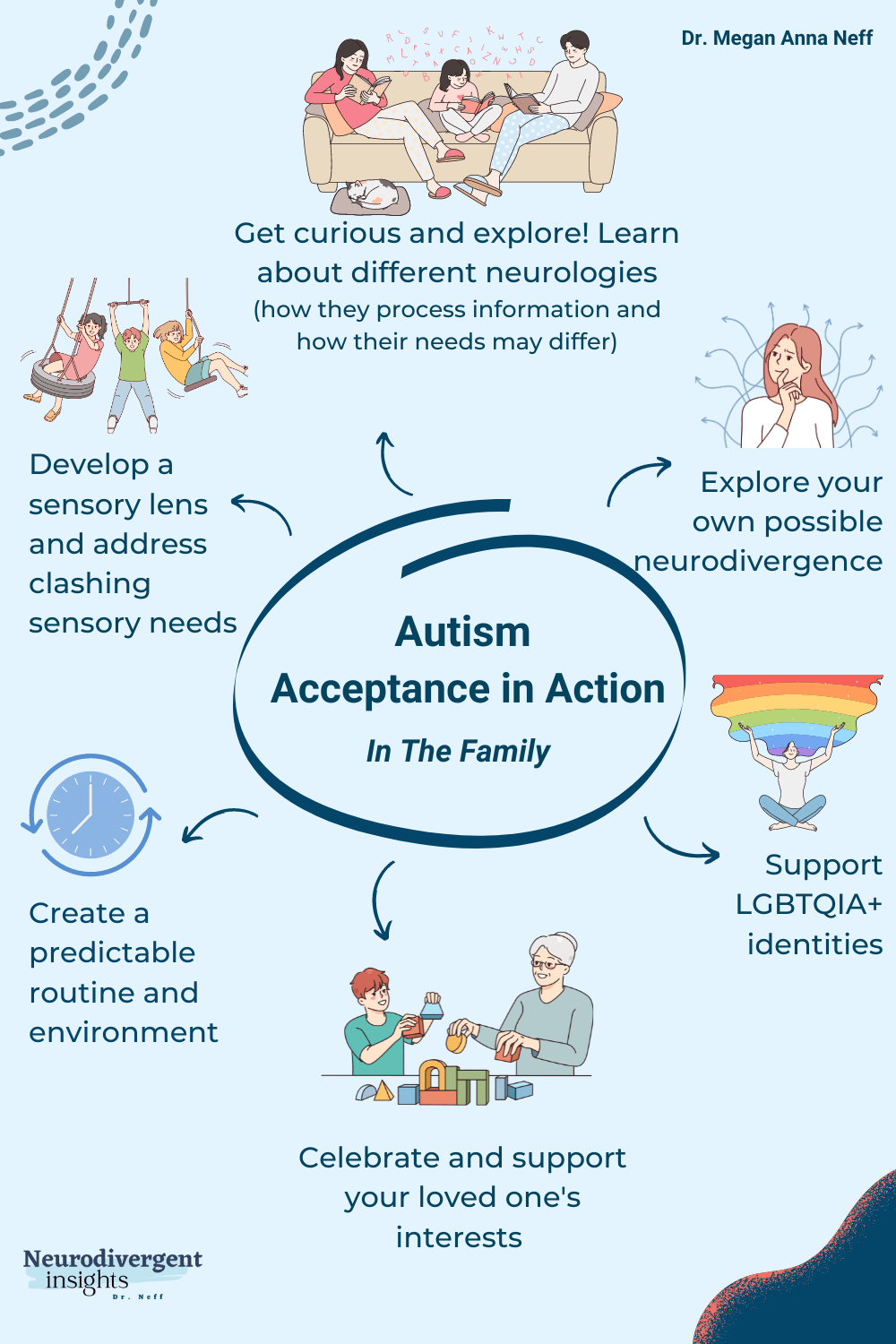
Autism Acceptance in Action

https://neurodivergentinsights.com/blog/autism-awareness-acceptance

In this blog series, I want to explore concrete ways individuals can practice autism acceptance in different contexts. In this post, I'll share some examples of what it means to embrace and practice autism acceptance. This is by no means an exhaustive list, and there is a wide variance of support needs within the Autistic community. But here are some practical steps to incorporate autism acceptance into action. 

Autism Acceptance in Families

Arguably the most critical acceptance starts in the family. Families play an integral role in the well-being of Autistic individuals. How a family does or does not accommodate, support, and accept autism will significantly impact the person's developing sense of self and worth. 

Autism acceptance within the family involves recognizing and embracing neurodiversity and honoring each individual's needs and strengths. This includes creating a safe and supportive home environment that allows for sensory regulation, neurodivergent communication, and connection. By embracing and celebrating neurodiversity within the family unit, families can help empower, encourage the integration of Autistic identity, and foster a healthy sense of worth and self-esteem. While not an exhaustive list, here are some practices for creating an inclusive and supportive home environment for autistic individuals and their families.

Ideas for Autism Acceptance in Families:

Autism acceptance in action in the family

✦ Normalize stimming (self-stimulatory behavior, such as rocking or hand-flapping), which helps regulate our emotions and focus

✦ Develop a sensory lens and address clashing sensory needs

✦ Create a sensory-safe room or place where the family member can go to sensory-detox

✦ Celebrate and support your loved one's interests and lead with object-based conversations over social-based conversations

✦ Create a predictable routine and environment (Our family has used this huge whiteboard for years to map out the day/weekend and week routines visually)

✦ Get curious and explore! Learn about different neurologies (how different neurotypes process information and how needs may differ)

✦ Support LGBTQIA+ identities (given the high rate of overlap between the autism spectrum, gender spectrum, and sexual diversity-supporting, exploration and integration of LGBTQIA+ identities often plays an important role in supporting the identity integration of the family member)

✦ Explore your own possible neurodivergence! Parents often worry it is "selfish" to explore their neurotype in the aftermath of a child's diagnosis. But this is one of the most powerful things you can do. It may help you to connect with your child, understand them, and for your child to feel understood by a parent in the household.

Autism Acceptance in the Classroom

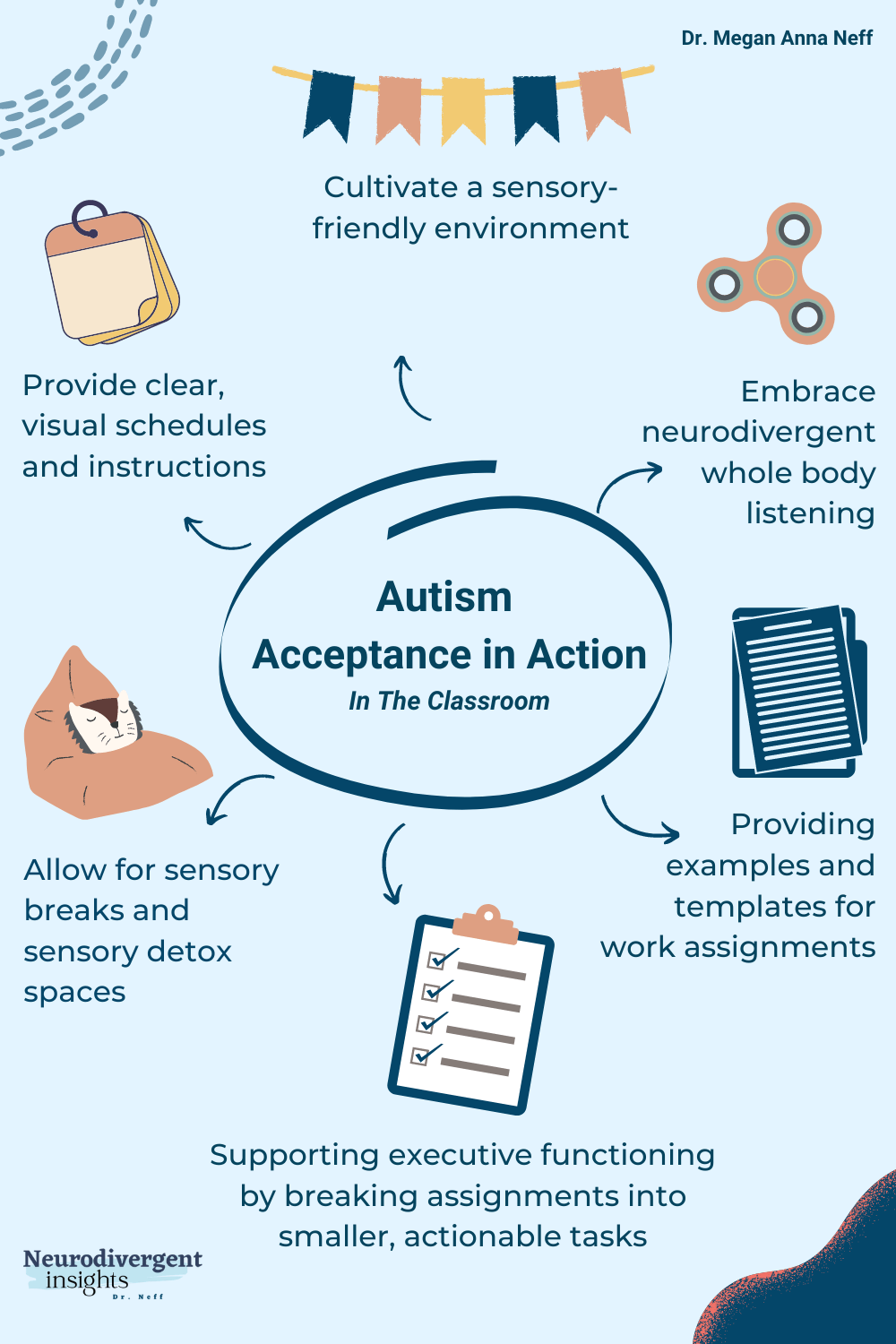
In the Classroom, Autistic students may have different learning styles and needs compared to their neurotypical peers. Embracing autism acceptance in the classroom means creating an environment that respects and accommodates multiple neurotypes. Ideas for Autism Acceptance in the Classroom:

Autism awareness and autism acceptance in the classroom

✦ Normalize stimming (self-stimulatory behavior, such as rocking or hand-flapping), which helps us regulate our emotions and focus

✦ Embrace whole-body (neurodivergent) listening. Whole-body listening for neurodivergent people may involve fidgeting, moving our bodies, doodling, or more

✦ Keep visual clutter to a minimum. For those of us with visual sensitivities, visually chaotic environments can cause cognitive and sensory overload

✦ Encourage sensory regulation by providing sensory breaks and sensory detox areas

✦ Accommodate interoception differences. Create a system that allows students to urgently use the bathroom when needed (vs. being excused)

✦ Provide clear, direct instructions and provide examples and templates when possible

✦ Providing visual aids and written instructions to help with executive functioning difficulties

✦ Allowing for sensory breaks or accommodations such as noise-canceling headphones or fidget toys

✦ Encouraging and incorporating students' special interests

✦ Creating a quiet or low-stimulation area for the student to retreat to if needed

✦ Being mindful of sensory sensitivities when planning classroom activities or events

✦ Support executive functioning by breaking large projects down into smaller tasks and actionable steps

✦ Provide clear, visual schedules and instructions

Resource: Check out everyday regulation for the Whole Body Listening (Neurodivergent edition) poster and other great resources.

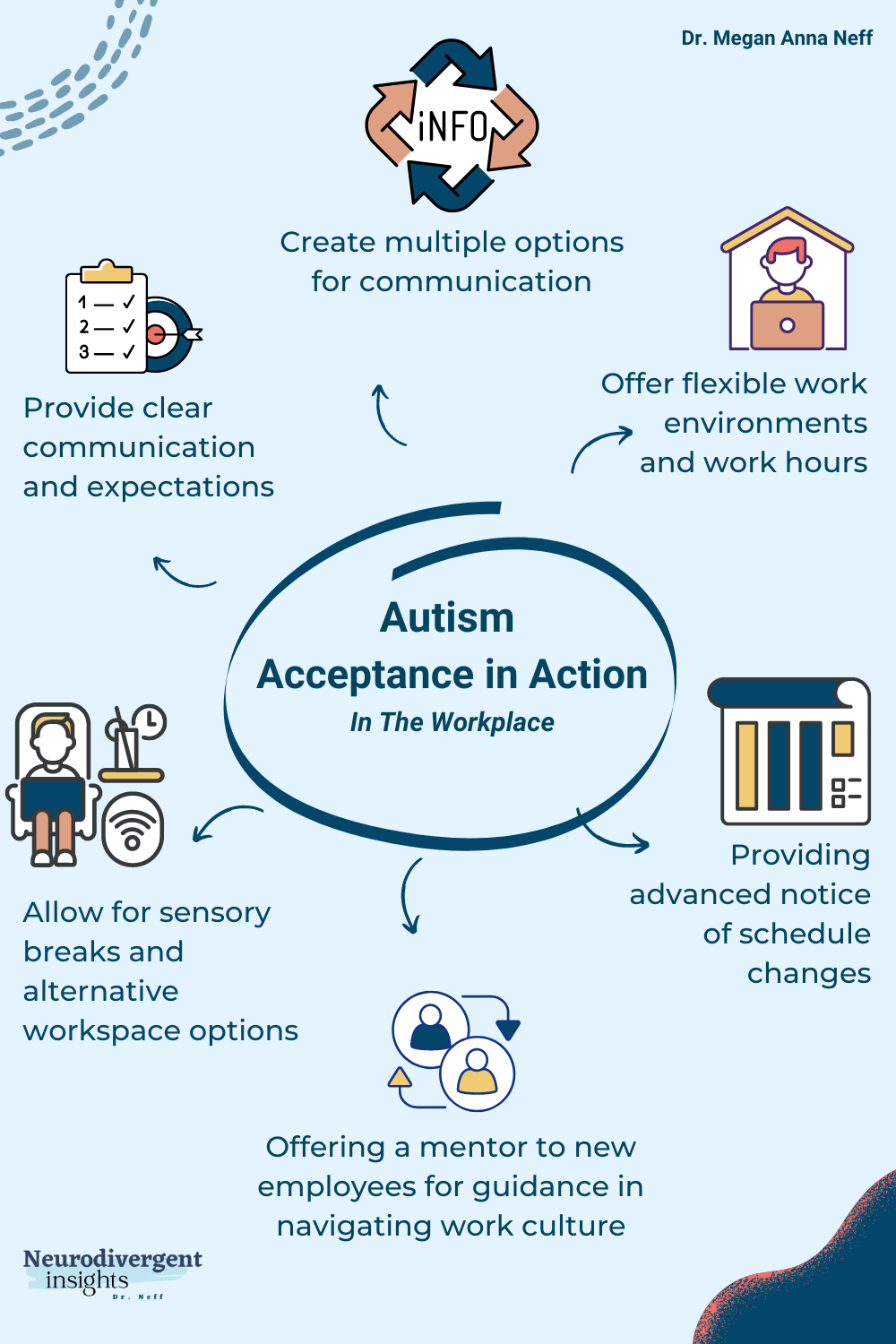
Autism Acceptance in The Workplace Autistic people have valuable skills and strengths that can contribute to the workplace. However, these skills are often not fully materialized due to sensory and communication barriers we experience in the workplace.  Embracing autism acceptance in the workplace means creating a culture that respects and values a diversity of brain styles. This could involve providing sensory-friendly workspaces, flexible schedules, or alternative communication methods to accommodate different work styles and needs. Ideas for Autism Acceptance in the Workplace:

Autism acceptance and autism awareness in the workplace

✦ Offer accommodations such as noise-canceling headphones

✦ Include regular education about neurodiversity in the workplace 

✦ Celebrate and utilize employee strengths and interests

✦ Offer autism-specific training for supervisors and managers

✦ Provide clear communication and expectations

✦ Offer flexible work environments and work hours when possible

✦ Create multiple options for communication

✦ Allow for sensory breaks and alternative workspace options

✦ Offering a mentor to new employees for guidance in navigating work culture

✦ When possible, provide advanced notice of schedule changes

Resource: Mentra is an excellent resource for neurodivergent people seeking employment. Mentra is a neurodivergent-friendly work platform that intelligently matches neurodiverse individuals with employers that value their strengths (created by and for neurodivergent people).

Autism Acceptance in Society

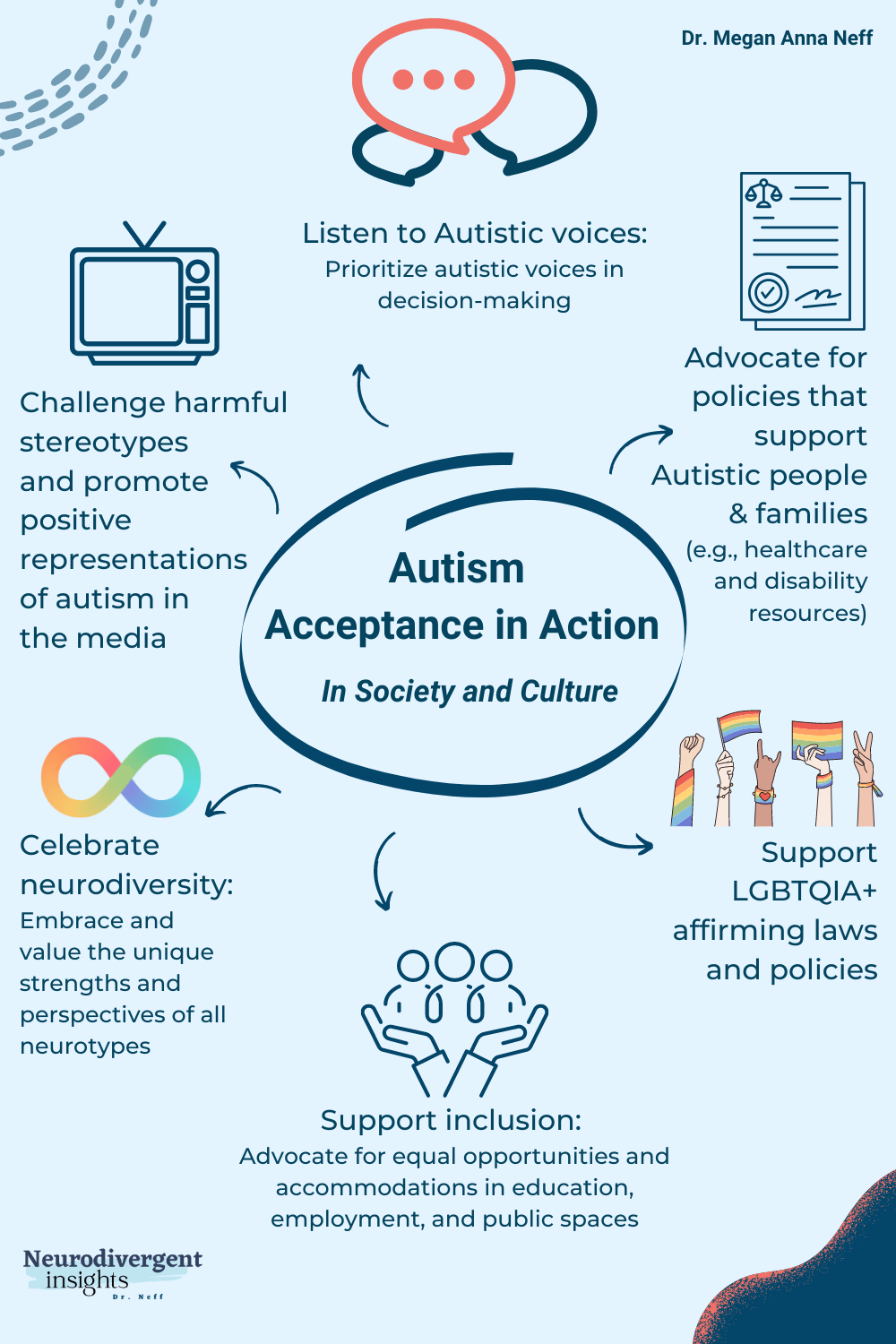
Autistic people have a long history of being excluded and marginalized from society. Autistic people face societal barriers and stigma due to a lack of understanding and acceptance of our neurological differences. Embracing autism acceptance in society means challenging these stereotypes and promoting a culture of inclusion and understanding. It means embracing diverse neurotypes as a valid way of being in the world.  This could involve advocating for policy changes that support the rights and needs of Autistic individuals, promoting representation of Autistic voices in media and public spaces, or simply educating others about the diversity and benefits of living in a neurodivergent world. It could also include accommodations for sensory needs in public spaces, education and employment opportunities that value neurodiversity, and medical care that respects the autonomy and agency of the Autistic individual. It also means challenging the harmful stereotypes and myths about autism that still persist, such as the idea that Autistic people lack empathy or are unable to form meaningful relationships. By recognizing and celebrating the diversity of autism, we can create a society that is truly inclusive and accepting of neurodiversity.

Autism Acceptance and Awareness in Society and Culture Infographic

Ideas for Autism Acceptance in Society:

✦ Support LGBTQIA+ affirming laws and policies

✦ Celebrate neurodiversity: Embrace and value the unique strengths and perspectives of all neurotypes

✦ Challenge harmful stereotypes and promote positive representations of autism in the media

✦ Listen to Autistic voices: Prioritize autistic voices in decision-making

✦ Support inclusion: advocate for equal opportunities and accommodations in education, employment, and public spaces

✦ Advocate for policies that support Autistic people & families (e.g., healthcare and disability resources)

Resource: ASAN is a great resource for getting involved in Autistic self-advocacy and advocacy initiatives. Conclusion: Autism Awareness and Acceptance Autism awareness and acceptance are not just buzzwords or trendy slogans. It’s not a checkbox we complete once a year. It involves ongoing efforts to address internalized and structural ableism and build a more inclusive society. Embracing autism acceptance also means more than just acknowledging the existence of autism. It is a mindset and a way of living that values and affirms the dignity, autonomy, and contributions of Autistic individuals.  Autism acceptance in action means actively promoting understanding, accommodation, and inclusion for Autistic people in all areas of life. From family homes to classrooms to workplaces to public spaces, we can all take practical steps to put autism acceptance into action and create a more affirming world for all neurotypes. By putting autism acceptance into action, we can create a world that truly celebrates and values neurodiversity.

Sunday, March 31, 2024

Monday Motivator #29 2023-24


Why You Need To Freshen Up Your Class Routines

Smart Classroom Management: Why You Need To Freshen Up Your Class Routines

This time of year things tend to get sloppy.

Students are feeling the lazy pangs of summer approaching. It’s in the tea, the daily grind, and the changing weather.

Left alone, this feeling will morph into poorer and poorer performance. Only you can do something about it. Because it will never correct itself.

There are a number of ways.

You can spend time preparing ever sharper and more compelling lessons. You can update seating arrangements, juggle the schedule, and raise your standards. You can announce a cool new project.

But the easiest way is to freshen up your routines. Here’s how in three steps.

Step #1

Change each routine in at least one significant way. It can be combining two or more routines into one long routine. It can be adding steps to an existing routine.

It can be short-cutting, adjusting a route, or speeding up the pace. Whichever you decide, be sure that the change offers a greater challenge. This is key.

Step #2

Include an aspect of fun. If you add an extra step, make it creative or amusing. (For example, walking to an X taped to the floor and dancing a one-second jig.)

If you’re combining or shortening a routine, then add a quick fist bump, odd movement, or silly facial expression at the end. It sounds weird, I know, but it works.

Step #3

Be sure you have fun with it. How you model your new routines makes all the difference. Teach them as a positive and a benefit to the class. Express yourself. Playact. Dramatize.

But be precise. Teach your new routines with exacting expectations. Then, just like the first week of school, let your students practice. Give feedback and praise. The practice should also be fun.

Note: The younger the students the more routines and modeling you’ll do.

A Weekly Jolt

The best part about changing routines, and the whole purpose of it, is that it transfers to everything you do.

It will awaken your sleepy class and improve their energy and motivation. It will erase the malaise and drudgery of the last weeks of school and provide the spark you need.

But you don’t have to teach all of your new routines in one day.

You can model one or two a week if you wish, which is a great option because it adds a jolt of fun and novelty every few days.

Just remember, like so much of effective classroom management, it’s the little things that make the difference.

https://smartclassroommanagement.com/2024/03/28/freshen-classroom-routines/

Monday Motivator #34 2025-26

  How Teachers Can Benefit From End-of-Year Reflections A teacher mentor shows why reflecting at the end of the year is so important for gro...