Sunday, April 10, 2022

Monday Motivator #31 2021-22

When we're lifting a heavy load

for when the challenge we're facing feels impossible


Listen to the 5 minute podcast here.

I needed to move something pretty heavy from one spot to another. This item is physically larger than I am, and frankly, the sheer disproportion between me and it was enough of an excuse to tell myself that it was immovable.

But there was something in me that knew it wasn’t. When I looked behind my fear, what I saw were lots and lots of questions.

Did I need to ask for help? Did I need to wait until I could come up with another solution? Or did I need to take a deep breath, bend my knees, and lift from my core?

When we’re lifting a heavy load, it can be easy to focus on the size of the load. To fixate on how huge the challenge in front of us seems to be. But when we peek behind the load before us, sometimes what’s hiding are the questions we need to let bubble to the surface so we can decide what to do next.

The questions might feel like a flood. Like even more challenges we need to deal with. But the questions are there to help us shift gears from wondering whether there’s anything we can do, to taking action and making an intentional choice.

Once I let the questions simmer, I was able to make a choice.

Apparently, it wasn’t immovable after all. 

Sunday, April 3, 2022

Monday Motivator #30 2021-22


How To Be A Better, Calmer Teacher With Visualization

smart classroom management: how to be a btter calmer teacher with visualization

Daily visualization will make you a calmer, more effective teacher.

And it works immediately.

Try it just once before school and you’ll have an easier day of teaching. Here’s how to do it:

1. Close your classroom door.

2. Sit or stand in place.

3. Breathe.

4. Visualize your day.

Visualization is nothing more than seeing yourself performing your job well. Whatever you visualize tends to happen more effortlessly.

It primes your subconscious to take the wheel, which frees you to enjoy your day without the typical strain and stress you’ve grown used to.

I recommend visualizing three areas:

1. Schedule

This is where you’ll watch your day unfold in fast motion. You’ll observe your students happily arrive and then listen, participate, and do their work until they leave for the day.

You’ll also see yourself at peace and in good humor.

Move chronologically through each period, ticking off your responsibilities. This will allow you to be more efficient and purposeful once the day begins. You’ll feel unhurried, as if you’ve been here before. Because you have.

2. Consistency

Here you’ll see yourself following through like a referee. Picture your most challenging class or difficult student and you fulfilling your promise calmly.

Come up with worst-case scenarios and you handling them with aplomb.

Visualizing this area will do wonders for the ease in which you follow your classroom management plan. The feeling is like being on autopilot.

You see the misbehavior and you enforce a consequence. Visualization makes you realize how simple it really is—and within the safety of your own mind.

3. Lessons

You can also run through your lessons chronologically. See yourself giving the introduction and the way you’ll capture attention. Choose a story or funny anecdote that you may use.

Watch as you model and explain the activity or assignment, check for understanding, and answer potential questions.

It’s no different than an athlete who visualizes their competition ahead of time, and just as effective. Whatever you rehearse in your mind’s eye will be easier and more effective when it comes to pass.

A Sure Way to Get Better

The biggest worry about visualization is that you’re adding yet another item to your plate. But here’s the thing: It takes only a couple of minutes at most, especially as it becomes a habit.

I can visualize my day in about 30 seconds and a lesson in half that time. It’s a fast-motion activity that very briefly touches on highlights and key areas.

The beauty of it is that it’s a surefire, practical way to get better at your job.

Again, it works the very first time you use it and without any extra burden. It also gets easier with time as you become a better, clearer, and more efficient visualizer.

See success, and that of your students, before it happens.

And that’s what you’ll get.

Sunday, March 27, 2022

Monday Motivator #29 2021-22


An Elixir for Writers


You can’t edit a blank page.
—Nora Roberts

Giving space to talk is one of the secret weapons of teachers of writers. I used to believe that writers needed silence. The silence was loud in my classroom, and truth be told, it was uncomfortable. Writing was painful for everyone in those days.
I was worried that if I offered time to talk, students wouldn’t be on task, and time would be wasted. I worried about a lot of silly things when I first started teaching. So day after day, silence weighed heavy in our classroom, bogging down fingers and stunting the words moving to the page.
If kids aren’t writing, then it is difficult to teach writers. Something needed to be done to loosen the words on the page. There are a lot of gimmicks that promise to do this. They are tempting in their guarantees to get kids to write, and provide teachers with “stuff” for students to do. Yet I wasn’t convinced my students needed more busywork. They needed to write.
The more I investigated how writers work, the more I realized that most writers talk about writing. They might not verbalize every single plot twist, but most writers have a buddy or two with whom to talk about their ideas and figure out the snags.
In a prepackaged world it may feel counterintuitive to simply give space for students to talk as writers. You don’t need a fancy slide with bulleted questions or a cute worksheet to record questions and responses. All you need is a routine designed to get students talking as writers.
Talk is an elixir for writers. Having a few moments to chat lets the words slide onto the page more easily when students are given the time to write. It’s simple but true. 

Shine on!
Ruth Ayres
Editor in Chief

Sunday, March 20, 2022

Monday Motivator #28 2021-22


Looking Back to Move Forward 
Bitsy Parks


It was the first day back after winter vacation, and I looked at the plans that I had penciled in the week before break. “Review reading workshop expectations: independent reading, reading habits, tricky word strategies, and text connections.” Later in the week my plans were a little more exciting, such as introducing new books, including Caldecott contenders, and starting a new reading unit on characters and questioning. After the long break it’s hard to know just where to start back in, so I didn’t question my plan, and sat down with my first graders.

During our community circle earlier that morning, I had heard about their vacation adventures and their favorite holiday treats. Many students looked excited to be back, a few were a little unsure, and all of them looked a little tired, as did I. It’s always hard to transition back to alarm clocks and cold, wet mornings. As I gathered my students on the rug to teach my reading lesson, reviewing workshop expectations, I looked out at their expectant faces and knew my penciled-in plans weren’t going to work. In that split second I knew I didn’t have the desire to routinely review anchor charts and learning from the fall as I had written in my plans. I knew I needed and wanted something more: a less boring lesson and, more importantly, a lesson that engaged my students, letting them actively participate and practice the learning we had done all fall.

Right then I revised my lesson plan. Instead of following the typical minilesson structure, I simply told my students to think of all they had learned in the fall and turn to share with a partner. I told them to think about how I taught reading lessons and about the charts we had made to record our thinking. Then I told them that today they would be the teachers. Using what they knew about my teaching, especially the anchor charts that we had created, today they would teach their classmates. With their reading partner, they would talk and remember all they could about our learning before vacation. And then the two of them would create an anchor chart of the most important learning to reteach their classmates. Once I gave them these instructions, I quickly reviewed aspects that made a good anchor chart, and off they went.

While students took time to talk with their partner, I scrambled to gather supplies for chart making. After pairs told me they had a plan, I gave them a chart-size sticky note. Students drew and wrote, and when they were finished, we hung our charts around the room and studied each other’s words. We shared what we noticed about the charts and what good learning we were reminded of.

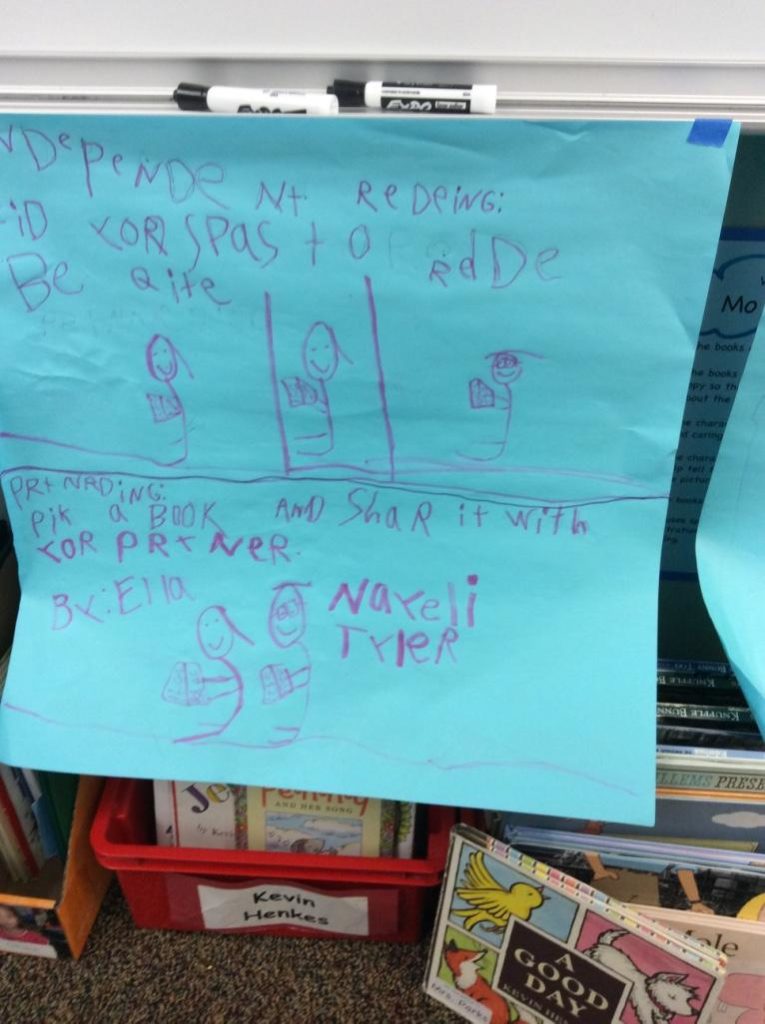
For example, this chart explained what students had learned about independent and partner reading in words and pictures:

Independent Reading:  

Find your space to read.  

Be quiet.

Partner Reading:  

Pick a book and

Share it with your partner.

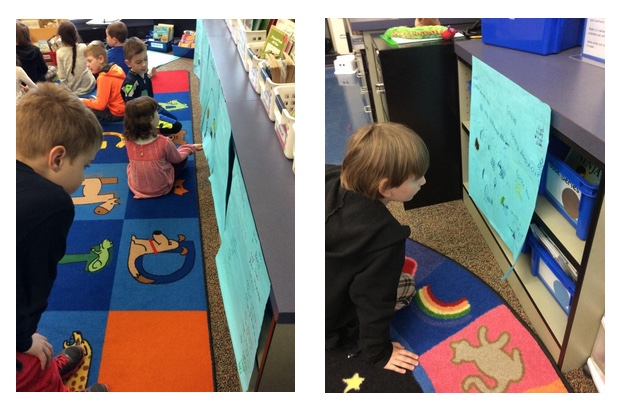
Students were thoughtful and respectful while studying their peers’ work:

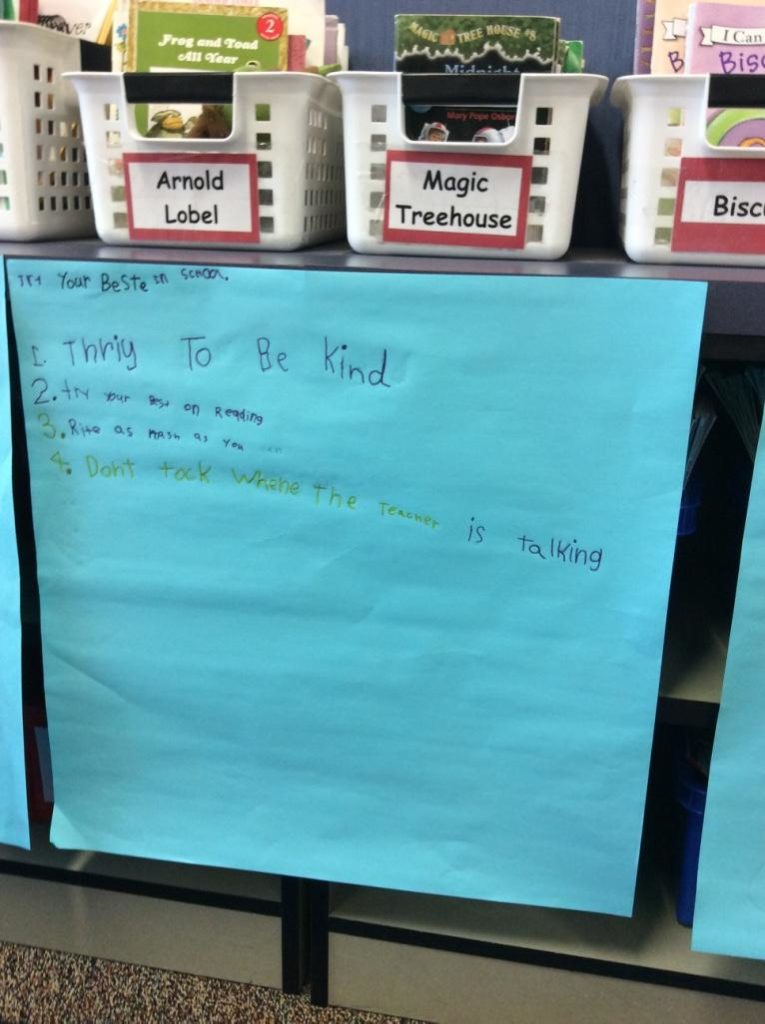
        Although this chart isn’t specific to reading workshop, I found it sweet to see what this partner team thought was important to remember about our class.

    Try your best in school.

  1. Try to be kind.

  2. Try your best on reading.

  3. Write as much as you can.

  4. Don’t talk when the teacher is talking.

This lesson was a spur-of-the-moment decision but got the kids engaged, working together, and reviewing our fall lessons. And the review didn’t just involve my students; it let them lead it! We wrapped up the day energized and confident that we were ready to jump back into our workshop routines.

This year as I prepare for break and our return in January, I will definitely revisit this lesson. With a little more thought, planning, and preparation, such as having the materials ready to make the posters and giving students an anchor chart format, I look forward to seeing what my students will come up with to review and to teach each other!

https://choiceliteracy.com/article/first-grade-reflections-looking-back-to-move-forward/

Sunday, March 6, 2022

Monday Motivator #27 2021-22


Student Self-Assessment Strategies


Over the course of the year, I have watched my daughter’s level of engagement rise in the work she does for her high  school English class. In her AP English class, she is asked to grade herself and present the evidence for her self-assessment to her teacher at the end of each marking period.

I have been trying to replicate this experience with some of the fifth graders in our district. The class has just completed  the first argument essay within their Research-Based Essay unit, and they are getting ready to begin a second one on a different topic. Before they begin, I want them to evaluate themselves as researchers and writers and set some goals for the rest of the unit. Therefore, I talked to some of them about grading their own papers and thinking about their strengths and weaknesses.

Through our conversations, it became clear that the students were not sure how to clearly state their strengths as writers or their areas for improvement. We grade student writing with an analytic rubric that has indicators for six traits of writing: focus, organization, elaboration, fluency, voice, and conventions. Our students have seen these rubrics for three or four years, yet when I asked them what these traits really entailed, they weren’t sure.

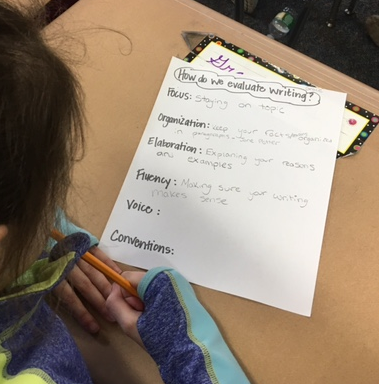
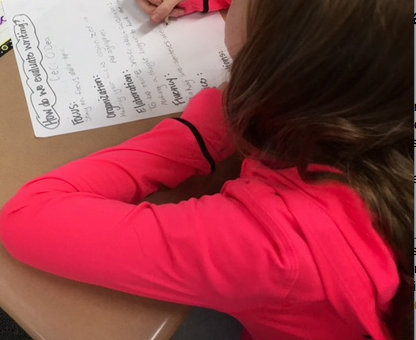
I asked their teacher if I could try a new lesson with his class, and the next day, I presented them with a blank chart of how we evaluate writing. Each student got their own copy of the chart, and my instructions to them were to try to describe in their own words what is meant by each trait of writing. I told them that I could describe each trait, but my language might not make as much sense as their own language. I really wanted to create a chart that had definitions that the students understood. As I came across responses that would help everyone, I handed out markers and asked students to share their ideas on a master chart.

As the master chart developed, their own personal charts developed as well.


Screen Shot 2016-01-30 at 5.39.28 PM.png

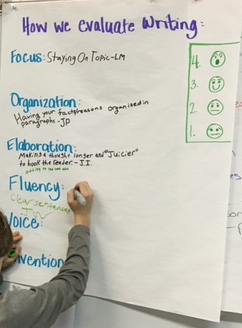
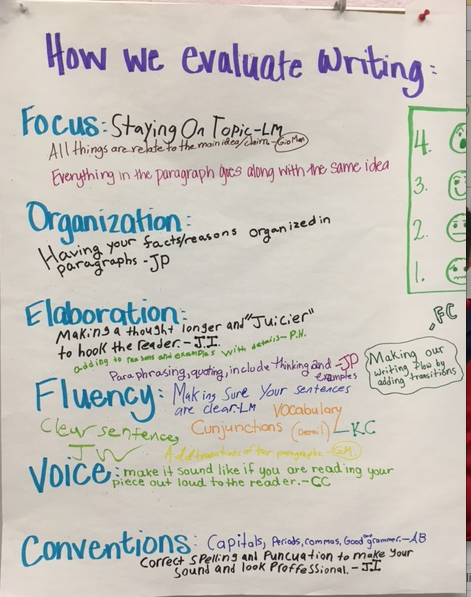
I emphasized to students to write only what made sense to them on their own paper. Everyone’s chart should look a little different, I said, but all of the students should end up with a tool that would help them evaluate their own writing. After about 15 minutes, we had a class chart that looked like this:

The only words I can take credit for on this chart are under Focus—“Everything in the paragraph goes along with the same idea.” The students came up with all the other indicators and even put their initials next to their ideas. The green faces on the right side of the chart indicate whether writers haven’t done too much within the trait (a “1”) all the way up to their doing an unbelievable job (a “4”).

The students’ next assignment was to self-assess their first essays. One student called me over to say that she was not sure about how to grade herself within the trait of fluency. On her own chart, she had very little written down for that trait. I suggested that she visit the classroom chart and see if there were other indicators that her classmates had written that would help her make decisions about her own writing. She took her own paper up to the front of the room and found two additional ideas about fluency. She was then able to decide on giving herself a 2+ for fluency. “I think in my next essay, I should try to have more transition words,” she said. I agreed. I might have been able to tell her that from just reading her essay, but the concept is much more powerful for her because she figured it out for herself. I can’t wait to see how her next essay goes!

I am always interested in ways to involve students in their own learning processes. Goals are important in all aspects of life, and at all ages. However, to set goals, we need to understand what we really want to achieve. Having students create their own set of indicators in language that they not only understand but actually come up with themselves will really help them be able to self-assess, set goals, and improve as writers and as learners.

Melanie Meehan

https://choiceliteracy.com/article/student-self-assessment-strategies/

Sunday, February 27, 2022

Monday Motivator #26 2021-22


3 Keys To Being Consistent

Smart Classroom Management: 3 Keys To Being Consistent

Consistency is the heart and soul of effective classroom management.

Without it, nothing works as it should.

And everything gets worse over time.

Behavior

Respect

Work habits

They continue to deteriorate until and unless you start following through. But how? That’s the big question. If you’re like most teachers, you struggle with consistency.

Sure, you may be determined. You may want, desperately, to be consistent.

But in the moment, when it’s time to enforce a consequence, you falter. Maybe not every time, or even most times. But letting it go even once in a while can have a profound effect.

To be 100% consistent, it must be easy for you to follow through and hard not to. What follows are three keys to doing just that.

1. Leave no doubt.

You and your students need to know precisely where your boundary lines are. They need to be modeled and defined to the degree that there is never, ever a doubt when they’ve been crossed.

In this way, breaking rules is a choice your students know they’re making ahead of time and can feel in their gut when they do—like the drop of a roller coaster.

Not only do sharply defined boundaries cut way down on misbehavior, but knowing exactly when the wall has been breached makes it so much easier to follow through.

2. Promise.

After ensuring your students know the rules backwards and forwards, make a promise to them that you will follow your classroom management plan as written and enforce a consequence every single time.

The soft pressure on your integrity, as well as the threat of your students losing all trust in you, is enough motivation to keep you from weakening and giving in. It provides the strength you need to get over your fear and awkwardness.

It gives you the push to do what you have to do in the moment, when it matters most.

3. Decide.

Experts say that it takes 66 days to form a new habit. Make no mistake, consistency is a habit. Teachers who are consistent don’t even think about it. For them, following through is no more challenging than brushing their teeth.

So how do you get there?

You make a conscious decision. Every morning before your students arrive decide that you will follow through no matter what—even if a herd of wildebeests were to come crashing through your classroom.

I know it sounds simple, but this one active choice is extremely powerful.

Just sit and close your eyes. Breathe and calm yourself for 30 seconds or so, and then decide that you’re going to abide by your plan come hell or high water. And remarkably, you will.

Do it every day and being consistent will become not just something you do . . . but who you are.

Bold & Trusted

I hear the argument often: “What if I don’t see the misbehavior?”

It’s your job to see it.

You must put yourself in position, both physically and with the detailed way you teach your classroom management plan, to be able to recognize rule-breaking the second it happens.

Vigilant supervision is a must.

In the meantime, know that the three keys above have been proven to transform even the most permissive teachers into bold and trusted leaders their students respect and want to behave for.

But it has to be important to you. You have to believe in the goodness of accountability. You must conclude that you’re sick and tired of all the stress and silliness and that you’re ready for the classroom you really want.

And now is the time to take it.

Sunday, February 20, 2022

Monday Motivator #34 2025-26

  How Teachers Can Benefit From End-of-Year Reflections A teacher mentor shows why reflecting at the end of the year is so important for gro...