Monday, September 6, 2021

Monday Motivator #3 2021-22


Bitsy Parks 

https://choiceliteracy.com/article/routines-for-building-gratitude/


It was a particularly dreary Northwest winter morning. It had rained all night, and as I hustled to the car to leave for school, I noticed puddles of standing water in our garden beds and walkways, and circling the lawn. I drove to school, windshield wipers slapping, and ran into the building, shaking my materials of the dripping water. The day ahead looked to be pretty routine, and on a day like that day, routine felt dreary also.
As I was moving about my room getting set up and ready for students, I noted action outside my window. I paused and looked out to see a district work crew working on our outdoor space. They were trimming grass, raking beds, cutting back overgrown bushes and trees, and yanking overgrown weeds. As an avid and aspiring gardener, I was so happy. The beds had been bothering me to the point that I had thought about finding time to visit the school on the weekend to take care of some problem areas.
In that moment I felt grateful to live in a place where gardening in the winter is a norm, and grateful to teach at a school that is so well cared for. These few minutes took my mind off the dreariness and actually reset my outlook. I felt more ready to welcome my students as they came into the room—a little damp, but their usual cheerful selves.
A lot of research and a lot of articles are floating around about the importance of exercising gratitude and how it can actually rewire our brains for the better! These are a few simple routines that I’ve woven into our classroom to build gratitude in my students.

First-of-Day Community Circle
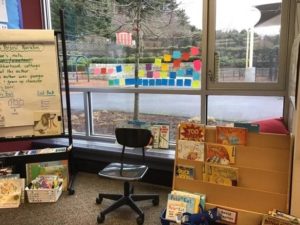
After our morning greeting, our community circle often opens with “Does anyone have any reading or writing news to share?” This particular morning I shared about my morning and how seeing the playground area get cleaned up made me feel grateful for our school and our space. “I’m wondering if any of you have gratitude to share,” I said. Hands quickly went into the air, and our class was filled with grateful thoughts and grateful hearts.
And just like that, a new routine was born. Now each morning our circle still includes invitations for reading, writing, or math news, and it also includes gratitude that anyone would like to share. The students’ shares are typical of first graders—they’re thankful for their moms packing their lunches, their families, their warm houses, and so on—but occasionally we hear a gratitude that is a little deeper and we all feel the gratitude sink in. Adding gratitude to our morning circle gives a moment of pause and starts our day in a grateful mindset.

Thankful Journals
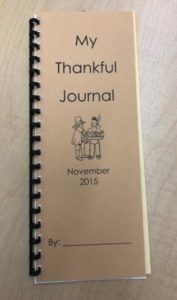
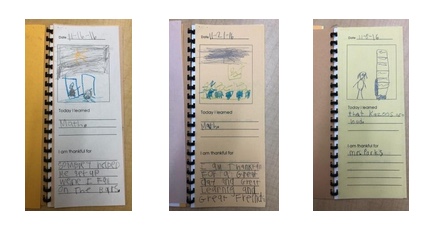
In my class we end each day with singing a song and doing hand motions together. I change the song each month, and we add the lyrics to our songs-and-poems folder. In November, in the spirit of Thanksgiving, I switch it up a bit. Rather than sing and do hand motions, we write in our thankful journal while a song plays. The journal is a simple half page (although for older grades I’ve used a full page), and students write responses to “Today I learned . . .” and “I am thankful for . . .” There is also a space for a small picture.
At the end of November I compile each child’s papers into a personal thankful journal. Their spirit of gratitude is encapsulated for as long as they keep the journal, and ideally a habit of gratitude and reflection is created. This routine is easy to modify and continue throughout the year.
Student Recognition

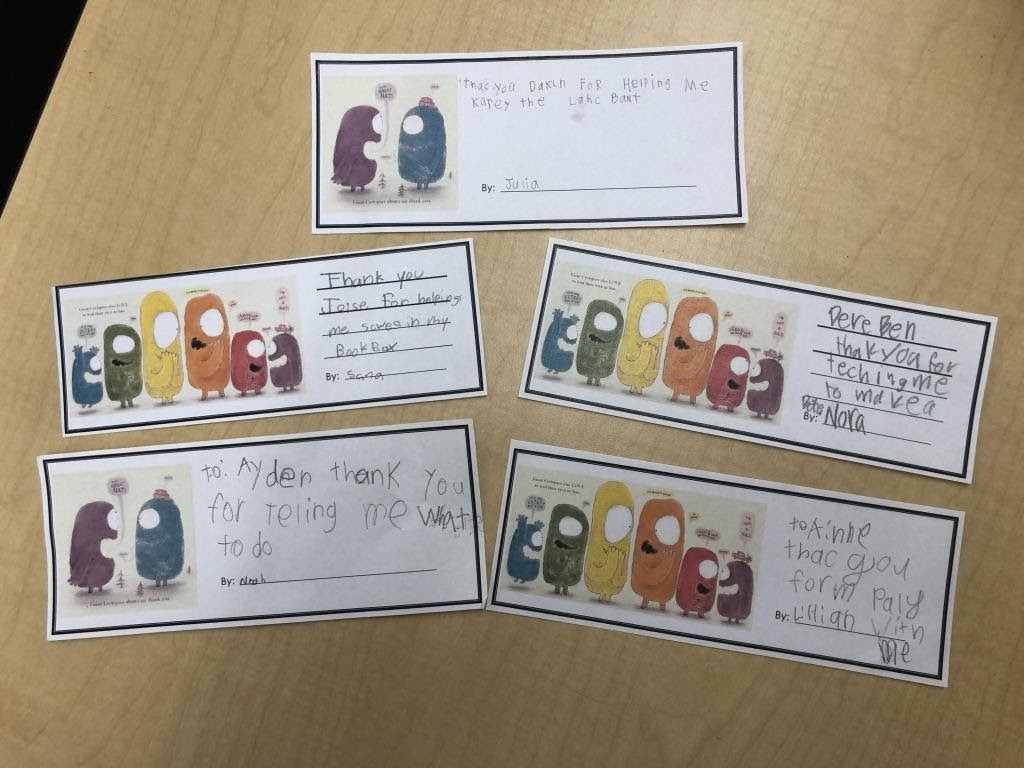
When building our community in September one of my favorite read-alouds is Rude Cakes by Rowboat Watkins. In this story Rude Cakes doesn’t have any concern for manners. One night she is accidentally kidnapped by a giant cyclops who happens to have really good manners. Rude Cakes learns the lesson that manners are useful, and she changes her ways.
After I read this with my students, we talk about manners and kind behaviors that we want in the classroom to make our community feel safe, welcoming, and encouraging. Then I offer students a place to notice friends who are showing giant-cyclops behaviors. We post and celebrate these papers throughout September and beyond. I find that often these become more about gratitude for each other than just pointing out behaviors.
Last-Day Community Circle

As we gather in our last community circle of the year, I pull out I Wish You More by Amy Krouse Rosenthal and read it to my attentive and quiet audience. “I am so grateful that I got to spend the year with all of you, and there are many things that I wish for you,” I tell them as I close the book. “Not just for the summer but for the many years ahead of you. I’m grateful for the opportunity to get to know all of you and your families this year. I’m grateful for the thinking we did together around the books we read, and I wish for you fun and friends and adventures,” I say. “I wish that you will come back to visit as often as you can. I also wish you lots of good books!” Even at this young age, they almost sigh and roll their eyes at my predictable book comment. “It’s your turn to share a gratitude and a wish for yourself or your classmates . . . ”
These small routines are quick and easy to add to a classroom day, yet the benefits are huge. They add kindness and thoughtfulness to our community and maybe even help wire our brains for the better.

Sunday, August 29, 2021

Monday Motivator #2 2021-22

Think about creating one of these if you haven't already for when you have a hard day and need a reminder of why we do what we do. Have a great week!


Sunday, August 22, 2021

Monday Motivator #1 2021-22


9 WAYS TO START THE YEAR OFF RIGHT

Are you ready to head back to school? As a teacher start the year off right and prepare for success. These strategies will help you set the foundation for your classroom and create a space where you and your students will want to be every day of the school year. Get ready for the students to head back to school with these great tips! #backtoschool #backtoschoolthoughts #backtoschoolideas #school #classroom #teacher #teacherhacks#teacherproblems #firstdayofschool #beginningofyear

It’s back-to-school time.  Are you ready for it?  Here are nine tips for your first couple days of school that will get your year off to a good start.  My favorite is the last one.  It’s an important one!

GO SLOW

Very slow. So slow, it’s almost painful. Slower than you think you should. Okay, maybe not that slow. But, seriously, I spend the first hour going over classroom rules (in a fun and interactive way) and establishing procedures for pair sharing.   Then we establish Daily 5 procedures. Slowly.
Go slow so that your students don’t miss anything.  I want my students to know the expectations and exactly what to do in our class.

MODEL, MODEL, MODEL

Model the right way to do things. Model the wrong way to do things. Then, model the right way to do things.
This is established with Daily 5, but can be transferred to anything you want students to do. Walk in a line, put papers away, etc.
Model it. Have students model it. Have students model doing it incorrectly. Then have the same students do it correctly.

STOP

Stop and redirect when you see incorrect behavior (or when something annoys you). Then model some more. Call out the behavior. Don’t embarrass the students or make them feel bad, but do address inappropriate behavior.  If you don’t, students will think they can get away with it!

KEEP IT POSITIVE

I’ve decided this year to focus on positive behavior management. I’ve realized (don’t know how it took me 16 years!) that negative feedback doesn’t really work for those students that I really need to reign in.  My most difficult students don’t respond to negative consequences.
For most of my students, just establishing good practices and routines is enough to keep them in line with gentle reminders.
My most challenging students don’t need more negative feedback. They get enough of it at home and have had it in previous years. I’ve got one kiddo this year that is pushing all the buttons. It’s been a challenge to catch myself and try to redirect the behavior rather than become negative and turn toward a punishment mentality. I’m trying though!

Are you ready to head back to school yet? Here are 9 ways that you can start the year off right. These strategies will help you set the foundation for your classroom and create a space where you and your students will want to be every day of the school year.#backtoschoolteacher

ADMIT YOUR MISTAKES AND YOUR FEARS

Show students that you are a real person, too. There was a time this week when I couldn’t find a set of papers. There were times when I said something wrong (learning new processes is hard).
Admit that you don’t know it all.
It will ease their fears. We read Wemberly Worried (affiliate link) on the second day of school this week. I admitted that I worry that I won’t teach them well. I also admitted that I was afraid that they wouldn’t like me.
Just trying to make it real, people.

PLAN MORE THAN YOU THINK YOU NEED

Over plan for the first couple days or even weeks, until you figure out the rhythm of your classroom. It’s better to have more in your back pocket than you think you need.
After a couple of weeks, your classroom will develop a natural ebb and flow.  Things will fall into place and you’ll get a feel for how each day should work.  Until then, over plan.

COME UP WITH SOME SPONGE ACTIVITIES OR FILLERS

For those extra 10 minutes that you can’t do a full lesson, but you can’t do the next activity, have some quick activities in your back pocket to use when you have a couple of extra minutes.  This post has 80 Sponge Activities you can use.

DON’T FORGET TO SIT DOWN

While your students are engaged in an activity, sit down.
Really take a seat.
Watch them.
See how they interact with one another.
Observe the choices they make.
Look at their personalities and see how they work together to make your classroom unique.
As teachers, we hardly ever get a chance to sit down and observe the way our students interact with one another.  We’re so busy teaching that we’re not spending time learning about our students.  Plan some lessons that give them some downtime, so that you can sit and observe how they’re working together.

BREATHE

Inhale.
Exhale.
Relax.
Take some time for yourself. Treat yourself to a coffee, a massage, a pedicure, a cup of tea. Anything that allows you to breathe and reflect. I keep going and going and going, and I often forget about myself during the first few weeks at school.  It’s important to take time for yourself.

I hope your first few days of school go smoothly with few stressors and that your students are amazing learners!


Sunday, May 23, 2021

Monday Motivator #34 2020-21

We made it! Have a wonderful last week of 2020-21 school year!

Write a letter to your future self to be sent to you in a year or on a specified date to reflect and capture the highs and lows of this crazy year! You can have your students do the same.

https://www.futureme.org/


Sunday, May 16, 2021

Monday Motivator #33 2020-21


Close


Can't find what you are looking for? Contact Us


Listen to this post as a podcast:


Sometimes I will be going about my normal day and I’ll notice a negative haze has descended on me — some vague feeling of apprehension, guilt, or maybe self-pity — but I won’t have a clue where it came from. If I ignore this feeling, it just gets worse. But if I stop and try to trace it back to where it came from, I can usually pinpoint something: An off-the-cuff comment that sparked jealousy. A news preview that spun me into a worry spiral. The facial expression of an acquaintance that planted a seed of insecurity. Once I nail down the source of a bad feeling, I can think it through and make a plan to deal with it.

This practice can be applied to our teaching as well. The end of a school year is a natural time to reflect, and while it’s easy to find good questions for reviewing accomplishments and setbacks, I believe that to learn as much as possible from a reflection on your teaching, you have to let your gut talk, too.

Here are five questions that can help you listen to your body’s emotional responses and uncover problem areas in your teaching. Use when the year is done, before the start of a new semester, or any time it feels like things aren’t going well, but you just can’t figure out why. They will work best if you process them at a quiet time, when you can do each one slowly. If that’s not possible, just looking over the questions should sharpen your awareness of how your body responds to the different facets of your work.

[Download these questions in a free worksheet from my store at Teachers Pay Teachers]

1. Look around your classroom (or picture it in your mind). What parts of the room make you feel tense, anxious, or exhausted? What parts make you feel calm, happy, or proud?

Sometimes the reasons for these feelings will be clear — your back table is always cluttered, the traffic patterns in one part of the room were awful, a particular shelf contains materials that never got used, for an activity that never ended up happening. In other cases, the reasons may be deeper: You were hanging that poster right before you gave your class the worst yelling you’ve ever unleashed. Two kids got into a fight right by the pencil sharpener. The classroom phone reminds you of a terrible call you received.

After considering all parts of your room, pick 2 to 3 hot spots that need the most attention. These should be your priorities for change.

2. Open up your plan book (or spreadsheet, or wherever you keep your lesson plans from the year) and just start browsing, paying attention to how you’re feeling as your eyes meet certain events. What days and weeks give you a lift when you see them, a feeling of pride or satisfaction? Which ones make you feel disappointed, irritated or embarrassed?

You may not know exactly what made certain lessons great and others not so great, but your gut-level reaction will tell you there’s something to investigate. Did you take a risk that paid off in some exhilarating learning gains? Did you try something new that completely flopped? Do you see a lot of the same thing, over and over again? Were there times when your plans fell apart because you said yes when you should have said no?

Try to find common themes or patterns. What changes do you need to make so you feel less stressed about your workload, and more satisfied about how you design your students’ learning experiences?

3. Take a look at your student roster. What do you feel when you see each name? Which names make you feel relaxed, satisfied and proud, which ones make your chest tighten with regret, and which ones make your stomach tense?

Look for patterns here, too. If several students give you the same bad feeling, try to find the common thread between them. Is there a hole in your classroom management style? Are there quiet, well-behaved students you haven’t given much attention to? Do you need to learn more about working effectively with minority students? Do you lack confidence when working with students with autism?

Once you have identified some themes in the relationships you have with your students, choose 2 to 3 areas where you need to grow. And next year, consider collecting student feedback in a systematic way.

4. Mentally travel from classroom to classroom, picturing each teacher in the building. What are your feelings as you approach each one? Which coworkers give you a generally positive feeling, which ones are neutral, and which ones make you feel nervous, angry, or annoyed?

Your relationships with your colleagues have a huge impact on how you feel about coming to work every day. Are there Marigolds and Walnut Trees in your midst that you’ve never identified? Are there some strong, positive teachers in the building whom you feel intimidated by, but should probably get to know better? Is it time to fix a relationship that has been damaged?

After going through the faculty and staff, choose a few people with whom you need to change your relationship, whether by repairing it, limiting it, or nurturing it.

5. Look at the following professional practice “buzzwords.” As you read each one, do you have positive, negative, or mixed feelings? What other words have you heard a lot this year that give you a strong feeling one way or the other?

technology

differentiation

data

research-based strategies

Common Core

higher-level thinking

flipped learning

standards-based

student choice

PLC

If any of these words give you negative or hard-to-name emotions, chances are you’re feeling insecure about these topics. The struggle may be caused by policies you have nothing to do with, or they may indicate an area where you need to grow. If it’s the latter, this is an opportunity to take one weakness and face it head-on — make it a priority to develop your skills in that area.

IDENTIFYING PRIORITIES AND CREATING AN ACTION PLAN

After working through each question, take what you learned and turn it into a plan of action. For each of the five areas (classroom, planning, students, co-workers, professional practice) identify one or two priorities for change. They may be positives into which you want to put more energy, negatives you want to correct, or ambiguities that need more investigation. Then, jot down a concrete plan to address each priority, including deadlines when possible. Here’s a sample completed action plan, using the worksheet that’s available for download:Gut-Level-Reflection-Sample

THE FINAL STEP: SHARE WITH A FRIEND

The positive effects of doing this kind of reflection will be maximized if you and a few other teachers do the exercise, then share your results. We work too often in isolation, but we all have the same struggles. Opening up to other teachers is one of the best ways to grow as a teacher and love what you do.

Sunday, May 9, 2021

Monday Motivator #32 2020-21


Copy of Search - Canva (18).png

https://www.bespokeclassroom.com/blog/2017/5/14/10-songs-with-prompts-to-use-at-the-end-of-the-school-year-for-reflection

I can't believe that another school year is almost over!  Are you looking for super quick and easy reflective prompts to wrap up the end of the year?  Here is a list of TEN songs along with prompts to inspire reflective writing.

1.  "UNWRITTEN" BY NATASHA BEDINGFIELD

PROMPTS:  

  • What is still "unwritten" about this school year?  What is something you wished you had done differently?

  • What is still "unwritten" about your education?  What do you hope to accomplish next year?


2.  "SCHOOL'S OUT FOR SUMMER" BY ALICE COOPER 

PROMPTS:

  • What are your plans for the summer?

  • What do you want to accomplish this summer?

  • What is one thing you definitely do NOT WANT to do this summer?

  • What is one thing you definitely WANT to do this summer?

3.  "IN MY LIFE" BY THE BEATLES

PROMPTS:

  • What are you best memories of the school year?

  • What will stick with you from this school year?

  • How have you changed this year?  How are you different?


4.  "FIREWORK" BY KATY PERRY

PROMPTS:

  • What is your "firework" moment from the school year?  What accomplishment(s) will you celebrate?

  • What have you learned about yourself this year? 

  • What new strengths did you gain or discover about yourself this school year?


5.  "SAME LOVE" BY MACKLEMORE & RYAN LEWIS

PROMPTS:

  • What did you learn, realize, or experience about stereotypes, diversity, and tolerance this school year?

  • How did you come to this realization?


6.  "SHAKE IT OFF" BY TAYLOR SWIFT

PROMPTS:

  • What is a memory you want to "shake off" at the end of the school year?

  • What is something from this school year that you are not going to let get to you or bring you down?


7.  "(YOU GOTTA) FIGHT FOR YOUR RIGHT (TO PARTY)" BY BEASTIE BOYS

PROMPTS:

  • What have you done this year to earn your "right to party"?

  • What are your plans for the summer?


8.  "YOU'RE GONNA MISS THIS" BY TRACE ADKINS

PROMPTS:

  • What are you going to miss about this school year?

  • What are you going to miss about this class?

  • What will stay with you?


9.  "SORRY" BY JUSTIN BIEBER

PROMPTS:

  • Is there anyone you would like to apologize to at the end of the school year?

  • What would you say to this person?

  • What have you learned from this situation?


10.  "BRAVE" BY SARA BAREILLES

PROMPTS:

  • What did you do that was "brave" this year?  

  • How did you step out of your comfort zone, or how can you step out of your comfort zone next year?

Sunday, May 2, 2021

Monday Motivator #31 2020-21

If You Didn't Hear This From Anyone Today

Just so you know, dear teacher friend, you're not alone and that the mental focus you give to your students is noticed. There are many other things that separate us as teachers from any other profession, but I think the thing that floors me most is the sheer amount of mental time and mental energy we give.

So, here it it is... If you didn't hear this from anyone today {{and even if you did}}...


Happy Teacher Appreciation today and EVERY day!


Monday Motivator #34 2025-26

  How Teachers Can Benefit From End-of-Year Reflections A teacher mentor shows why reflecting at the end of the year is so important for gro...