Sunday, May 16, 2021

Monday Motivator #33 2020-21


Close


Can't find what you are looking for? Contact Us


Listen to this post as a podcast:


Sometimes I will be going about my normal day and I’ll notice a negative haze has descended on me — some vague feeling of apprehension, guilt, or maybe self-pity — but I won’t have a clue where it came from. If I ignore this feeling, it just gets worse. But if I stop and try to trace it back to where it came from, I can usually pinpoint something: An off-the-cuff comment that sparked jealousy. A news preview that spun me into a worry spiral. The facial expression of an acquaintance that planted a seed of insecurity. Once I nail down the source of a bad feeling, I can think it through and make a plan to deal with it.

This practice can be applied to our teaching as well. The end of a school year is a natural time to reflect, and while it’s easy to find good questions for reviewing accomplishments and setbacks, I believe that to learn as much as possible from a reflection on your teaching, you have to let your gut talk, too.

Here are five questions that can help you listen to your body’s emotional responses and uncover problem areas in your teaching. Use when the year is done, before the start of a new semester, or any time it feels like things aren’t going well, but you just can’t figure out why. They will work best if you process them at a quiet time, when you can do each one slowly. If that’s not possible, just looking over the questions should sharpen your awareness of how your body responds to the different facets of your work.

[Download these questions in a free worksheet from my store at Teachers Pay Teachers]

1. Look around your classroom (or picture it in your mind). What parts of the room make you feel tense, anxious, or exhausted? What parts make you feel calm, happy, or proud?

Sometimes the reasons for these feelings will be clear — your back table is always cluttered, the traffic patterns in one part of the room were awful, a particular shelf contains materials that never got used, for an activity that never ended up happening. In other cases, the reasons may be deeper: You were hanging that poster right before you gave your class the worst yelling you’ve ever unleashed. Two kids got into a fight right by the pencil sharpener. The classroom phone reminds you of a terrible call you received.

After considering all parts of your room, pick 2 to 3 hot spots that need the most attention. These should be your priorities for change.

2. Open up your plan book (or spreadsheet, or wherever you keep your lesson plans from the year) and just start browsing, paying attention to how you’re feeling as your eyes meet certain events. What days and weeks give you a lift when you see them, a feeling of pride or satisfaction? Which ones make you feel disappointed, irritated or embarrassed?

You may not know exactly what made certain lessons great and others not so great, but your gut-level reaction will tell you there’s something to investigate. Did you take a risk that paid off in some exhilarating learning gains? Did you try something new that completely flopped? Do you see a lot of the same thing, over and over again? Were there times when your plans fell apart because you said yes when you should have said no?

Try to find common themes or patterns. What changes do you need to make so you feel less stressed about your workload, and more satisfied about how you design your students’ learning experiences?

3. Take a look at your student roster. What do you feel when you see each name? Which names make you feel relaxed, satisfied and proud, which ones make your chest tighten with regret, and which ones make your stomach tense?

Look for patterns here, too. If several students give you the same bad feeling, try to find the common thread between them. Is there a hole in your classroom management style? Are there quiet, well-behaved students you haven’t given much attention to? Do you need to learn more about working effectively with minority students? Do you lack confidence when working with students with autism?

Once you have identified some themes in the relationships you have with your students, choose 2 to 3 areas where you need to grow. And next year, consider collecting student feedback in a systematic way.

4. Mentally travel from classroom to classroom, picturing each teacher in the building. What are your feelings as you approach each one? Which coworkers give you a generally positive feeling, which ones are neutral, and which ones make you feel nervous, angry, or annoyed?

Your relationships with your colleagues have a huge impact on how you feel about coming to work every day. Are there Marigolds and Walnut Trees in your midst that you’ve never identified? Are there some strong, positive teachers in the building whom you feel intimidated by, but should probably get to know better? Is it time to fix a relationship that has been damaged?

After going through the faculty and staff, choose a few people with whom you need to change your relationship, whether by repairing it, limiting it, or nurturing it.

5. Look at the following professional practice “buzzwords.” As you read each one, do you have positive, negative, or mixed feelings? What other words have you heard a lot this year that give you a strong feeling one way or the other?

technology

differentiation

data

research-based strategies

Common Core

higher-level thinking

flipped learning

standards-based

student choice

PLC

If any of these words give you negative or hard-to-name emotions, chances are you’re feeling insecure about these topics. The struggle may be caused by policies you have nothing to do with, or they may indicate an area where you need to grow. If it’s the latter, this is an opportunity to take one weakness and face it head-on — make it a priority to develop your skills in that area.

IDENTIFYING PRIORITIES AND CREATING AN ACTION PLAN

After working through each question, take what you learned and turn it into a plan of action. For each of the five areas (classroom, planning, students, co-workers, professional practice) identify one or two priorities for change. They may be positives into which you want to put more energy, negatives you want to correct, or ambiguities that need more investigation. Then, jot down a concrete plan to address each priority, including deadlines when possible. Here’s a sample completed action plan, using the worksheet that’s available for download:Gut-Level-Reflection-Sample

THE FINAL STEP: SHARE WITH A FRIEND

The positive effects of doing this kind of reflection will be maximized if you and a few other teachers do the exercise, then share your results. We work too often in isolation, but we all have the same struggles. Opening up to other teachers is one of the best ways to grow as a teacher and love what you do.

Sunday, May 9, 2021

Monday Motivator #32 2020-21


Copy of Search - Canva (18).png

https://www.bespokeclassroom.com/blog/2017/5/14/10-songs-with-prompts-to-use-at-the-end-of-the-school-year-for-reflection

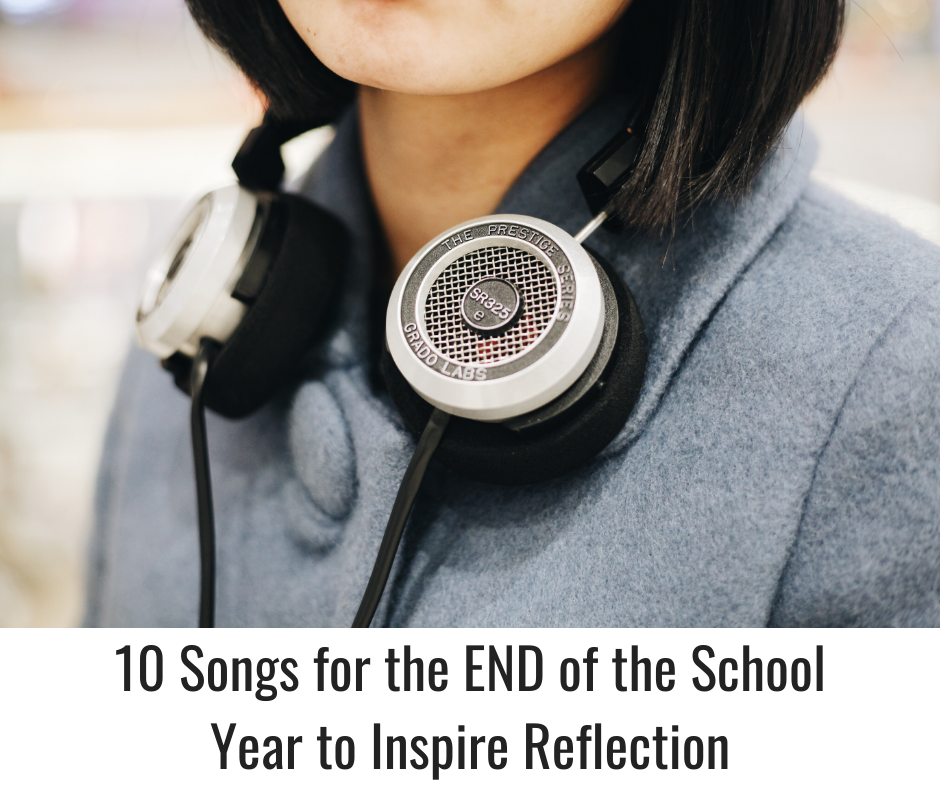
I can't believe that another school year is almost over!  Are you looking for super quick and easy reflective prompts to wrap up the end of the year?  Here is a list of TEN songs along with prompts to inspire reflective writing.

1.  "UNWRITTEN" BY NATASHA BEDINGFIELD

PROMPTS:  

  • What is still "unwritten" about this school year?  What is something you wished you had done differently?

  • What is still "unwritten" about your education?  What do you hope to accomplish next year?


2.  "SCHOOL'S OUT FOR SUMMER" BY ALICE COOPER 

PROMPTS:

  • What are your plans for the summer?

  • What do you want to accomplish this summer?

  • What is one thing you definitely do NOT WANT to do this summer?

  • What is one thing you definitely WANT to do this summer?

3.  "IN MY LIFE" BY THE BEATLES

PROMPTS:

  • What are you best memories of the school year?

  • What will stick with you from this school year?

  • How have you changed this year?  How are you different?


4.  "FIREWORK" BY KATY PERRY

PROMPTS:

  • What is your "firework" moment from the school year?  What accomplishment(s) will you celebrate?

  • What have you learned about yourself this year? 

  • What new strengths did you gain or discover about yourself this school year?


5.  "SAME LOVE" BY MACKLEMORE & RYAN LEWIS

PROMPTS:

  • What did you learn, realize, or experience about stereotypes, diversity, and tolerance this school year?

  • How did you come to this realization?


6.  "SHAKE IT OFF" BY TAYLOR SWIFT

PROMPTS:

  • What is a memory you want to "shake off" at the end of the school year?

  • What is something from this school year that you are not going to let get to you or bring you down?


7.  "(YOU GOTTA) FIGHT FOR YOUR RIGHT (TO PARTY)" BY BEASTIE BOYS

PROMPTS:

  • What have you done this year to earn your "right to party"?

  • What are your plans for the summer?


8.  "YOU'RE GONNA MISS THIS" BY TRACE ADKINS

PROMPTS:

  • What are you going to miss about this school year?

  • What are you going to miss about this class?

  • What will stay with you?


9.  "SORRY" BY JUSTIN BIEBER

PROMPTS:

  • Is there anyone you would like to apologize to at the end of the school year?

  • What would you say to this person?

  • What have you learned from this situation?


10.  "BRAVE" BY SARA BAREILLES

PROMPTS:

  • What did you do that was "brave" this year?  

  • How did you step out of your comfort zone, or how can you step out of your comfort zone next year?

Sunday, May 2, 2021

Monday Motivator #31 2020-21

If You Didn't Hear This From Anyone Today

Just so you know, dear teacher friend, you're not alone and that the mental focus you give to your students is noticed. There are many other things that separate us as teachers from any other profession, but I think the thing that floors me most is the sheer amount of mental time and mental energy we give.

So, here it it is... If you didn't hear this from anyone today {{and even if you did}}...


Happy Teacher Appreciation today and EVERY day!


Sunday, April 25, 2021

Monday Motivator #30 2020-21

 Reach for Your Notebook

https://choiceliteracy.com/article/april-23-2021-end-of-year-reflections/

Keep a notebook. Travel with it, eat with it, sleep with it. Slap into it every stray thought that flutters up into your brain. Cheap paper is less perishable than gray matter. And lead pencil markings endure longer than memory.
—Jack London


Anyone who knows me knows I am a notebook girl. In school, I have one with me at all times, and for the cover-to-cover life of that notebook, I’m a notebook monogamist—writing only in that one.

Over the years I’ve had smaller notebooks, larger notebooks, some with book bindings, some with spirals, some with lines, some with grids, and some with blank pages in white, cream, and brown craft. No matter the exterior or interior, each notebook is full of lists, reminders, quotes, meeting notes, ideas, sketches, doodles, and book titles. When I really want something to stand out, I affix a colorful sticky note to the page and add my note to that paper-like frame. Fancy.

When each notebook is full, I place it, in all its banged-up, traveled-back-and-forth-from-home-to-school-worn-glory, on my shelf. I line it up next to the one that came before it so that when I need to remember something, I can flip back through the chronological pages of the notebooks on a quest not unlike a kind of archaeological dig.

Today, I wrote on the last page of a trusty replica of a library-card Etsy-find. She was my second notebook of this year, and on deck is a stunning Pantone beauty I purchased way back in October 2019 at one of my favorite places on the face of the earth—the Strand in New York City—when I was there for a coaching conference with two of my close colleagues. For four days, the three of us crowded into a small hotel room at night, and shared nonstop conversations about what we were learning and the hopes for our schools over late dinners and on the long train ride home from the city. So this new one, this notebook purchased pre-pandemic at a time when I was in a crowded city that was so alive, feels extra special. Just looking at the pages and the color swatches sprinkled throughout fills me with joy.

However, as odd as this may sound, I'm always a little sentimental on new notebook days. It's strange to set something aside that's been a constant companion for so many weeks and months—and this one— well, it's been a really hard and oftentimes very lonely year at school, so there's a lot of tangled heartache in this little spiral.

Nevertheless, our days are becoming a little brighter, and even the hint of a closer-normal-school year on the horizon fills us with collective hope again. This new notebook’s destiny will be to capture moments of where we are, how far we’ve come, and how we will start again. As I crack the cover and my pencil is poised over the first pristine page, I'm proclaiming that good things and better days are going to happen in the active lifetime of this new notebook. I invite you to join me in this promise by reaching for your own notebook—in whatever form it might be—and to pick up your pen. 

Shine on!
Gwen Blumberg
Contributor, Choice Literacy

Sunday, April 18, 2021

Monday Motivator #29 2020-21


Pausing for Renewal Throughout the Day

By Stella Villalba

https://choiceliteracy.com/article/pausing-for-renewal-throughout-the-day/

Self-care means giving yourself permission to pause. —Cecilia Tran

The buzz of everyday school life can easily have us running around without much focus. In my role as a teacher leader and instructional coach who travels to different buildings within our district, my days are filled with voices, questions, and concerns.

Every day is different, and it is easy to feel overwhelmed. I enjoy working with people, and I’m outspoken and highly engaged wherever I am. But I’m also an extrovert with introvert tendencies, which for me means that I need alone time to recharge and refocus.

In a world of high demands and a variety of voices, I can’t help but ask, “How are we renewing our thoughts as educators every day?” Here are a couple of things I have learned and tried throughout the years. I understand that when it comes to self-care and renewal, consistency is the key. But I also understand that just having a set of tools to draw from helps me understand what to do when I start feeling crowded with thoughts.

Inspiration

The Note app on my phone has become one of my favorite tools. Not only does it serve as a great ongoing to-do list, but I can also organize information in folders that I can access anywhere. I like to add to this folder powerful statements from professionals I admire. Recently, I added this one to my repertoire:

Our kids aren’t going to outgrow us. If we want our kids to get better, we have to get better ourselves. —Cornelius Minor

Such a powerful reminder from Mr. Minor that as educators we are always becoming and that we must continue to grow professionally. Another powerful quote I currently have is from Justin Talbot-Zorn and Leigh Marz, who were inspired by the work of Ta-Nehisi Coates:

Generating good ideas and quality work requires something all too rare in modern life: quiet.

This particular quote has served me many times when coaching teachers. I must respect their quiet and processing time. They deserve it.

Visual Reminders of Strength

In my cloud folder, I keep an album of photos of students who inspire me to do this work daily. Some of them are photos from former students who remind me that they show up every day despite the work being difficult. Other photos are of current students who are keeping me curious about teaching and learning.

Whenever I receive a card or a letter from a student, I take a photo and add it to this album. It reminds me that someone does notice what we do, that what we do matters. I also like to keep a pocket chart in my oce or in my classroom to add any thank-you cards or notes I might receive throughout the year from other sta. It lifts me up to reread those cards. Every time.

Disconnect for Five Minutes

I have learned this strategy from a colleague who goes on a walk around the school every day (yes, even in winter). I would often sit in my office and, from my window, see her taking a relaxed walk around school. No music, no headphones, no cell phone, no distractions. I decided to try this myself. Even if it just meant that I would sit outside and catch some sun for five minutes. It didn’t cost me anything. I didn’t have to change schedules for it to happen.

In no time, I learned that those five minutes provided me with the calm and clarity I sometimes needed. Some days I just sat in my car and listened to my favorite song.

These three simple tools have helped tremendously during the year. There were times when I felt overwhelmed with other teachers’ voices. I couldn’t hear my own. And that bothered me.

There were other times when a situation with a child tested my patience and I needed to remind myself why I was in his or her life. Other times an extra five minutes of sun just kept me grounded and reminded me that people are just people.

Renewing my thoughts daily is my responsibility, because there will always be noise, questions, concerns, or just simply complaints that take away any calm or serenity I had first thing in the morning. I can’t control what happens, but I can choose what to do when those moments arise. 

Sunday, April 11, 2021

Monday Motivator #28 2020-21


Leaning Into Play

My family visits an indoor water park in Wisconsin Dells every year for a short early-spring vacation. It’s a popular destination and although we try to beat the spring break rush, we inevitably face some long lines. I actually love waiting in water park lines, because the majority of people don’t have a phone with them, so family conversations and laughter take priority over scrolling and screens. The slides at this particular water park aren’t for the faint of heart, so it’s a long climb to get to the top so that you can enjoy the trip down. Climb a few stairs, wait. Talk and laugh, climb a few more stairs. Wait.

It was in such a line two years ago that I noticed a ledge against the wall, fairly high up toward the ceiling of the water park. I don’t know what the ledge’s original purpose was, but it had become a target for ponytail holders. I chuckled to myself and told my daughters, “Look, over there. People must be trying to fling their ponytail holders from this line onto the ledge.” There must have been hundreds of elastic holders scattered on the ledge. I had so many questions. Who was the first person to fling their holder onto the ledge? How long did it take before someone else tried? How long had the hair ties been there? Was anyone from the water park going to clean them up? My daughter Maddie wanted to try the stunt herself but wasn’t quite willing to forgo her ponytail for the rest of the day. The line eventually moved, and we climbed a few more steps.

Imagine my surprise the following year when we returned to the water park. Same line, same slow crawl up the wooden stairs. I had actually forgotten about the ledge when something red caught my peripheral vision. I turned to look and let out a joyful “ha!” when I saw what the water-park staff had done. Apparently they had noticed the ledge full of abandoned elastic hair ties and had decided, rather than expending their energy on cleaning it up, to make it a game. There sat a large red-and-white target with a black peg sticking out of the bull’s-eye. It was a challenge, an invitation to play. Could you slingshot your ponytail holder onto the bull’s-eye? It looked like only a handful of people had done it, though many had tried and failed. People entered the line with a ponytail and left with their hair hanging down their back, unable to resist the challenge.

I think of that target often in my classroom. How often do I fight against the current? How often am I trying to figure out how to “clean up the hair ties” rather than just making it a game?

This year while I’m teaching 100 percent remote, I’m trying to lean into the unexpected and find moments to play. I had some days when the turned-off cameras and muted mikes began to take a toll. Rather than admonish the kids for not participating, I downloaded a crickets’ sound effect on my phone and played it during the silence. When a student insisted on having her dog, Rocco, on her lap and on camera for every single lesson, I added his name to our class roster.

What about you? What is something that could take a toll on you this year, but you’re claiming it as an opportunity to play?

Dana Murphy
Featured Contributor, Choice Literacy

Sunday, April 4, 2021

Monday Motivator #27 2020-21


Building Empathy With Stories

Develop social-emotional skills and empathy using fiction, nonfiction, and poetry.

By Nancy Zuckerbrod

Fourth-grade teacher Todd Flory enjoys reading Harry Potter with his students at Wheatland Elementary in Wichita, Kansas. But captivated as the kids are by Quidditch, floating candles, and paintings that talk, Flory is working with them on something else—building empathy.

“We use the book to talk about the importance of understanding and accepting people who are different,” Flory says. Through the medium of books, he feels he is helping students become more sensitive to the feelings and experiences of others.

Research supports the idea that reading can expand students’ worldviews and build empathy. In an article in an American Psychological Association journal, academics from Italy and the United Kingdom found that the Harry Potter books in particular helped students gain an understanding of others. That’s important, says David Kidd, a postdoctoral fellow at the Harvard Graduate School of Education who has studied empathy and literature. “We tend not to extend empathy to people in other groups as readily as we do to people in our own groups. By reading stories showing people who are different from us, it helps us see them as full people.”

Author Alan Gratz, whose book Refugee tells stories of children fleeing persecution, hopes his novel opens students’ minds and hearts to diverse experiences. “The plight of refugees is so far removed from many children’s lives, thankfully. But that distance means they are often unable to understand who these people are, and why they’re walking for days and weeks and thousands of miles to find new homes,” Gratz says. (His latest book, Grenade, deals with moral issues faced by Japanese teens during World War II.)

Want to use fiction, nonfiction, and poetry to build empathy and develop students’ literacy skills? Read on!

Learn From Fiction

“Literature is an excellent tool for building empathy. It’s like a match made in heaven,” says Heather Schwartz, practice specialist at the Collaborative for Academic, Social and Emotional Learning. “When we read stories, we ask ourselves, ‘Why is the character doing this? What’s going on with him or her?’”

Consider Wonder, by R. J. Palacio. It’s told from various perspectives and is about a boy named August who has facial deformities and is encountering school for the first time. One study conducted by a psychology professor at Virginia’s Mary Baldwin University in collaboration with a sixth-grade English teacher found that sixth graders who read Wonder showed improvement in looking at things from others’ perspectives. That’s no surprise to third-grade teacher Stacie Delaney, who teaches at Tabernacle Elementary School in New Jersey and has read the book with her students. “One of my students has a significant disability; she used to have a tracheostomy tube. My students understand that in the book, August looks different but that’s okay. We all look different,” she says.

Justin Minkel was teaching in New York City when terrorists struck on September 11, 2001. In the aftermath, Minkel noticed his fourth graders had absorbed negative stereotypes about Middle Easterners. He responded by bringing in books aimed at shattering those stereotypes, such as The Day of Ahmed’s Secret, by Florence Parry Heide and Judith Heide Gilliland, about a boy in Cairo. He had students write down what they thought they knew about people from the Middle East and then reexamine their assumptions after reading this book and others. “I asked, ‘Are the things we thought really right?’ And they realized they were not,” he says.

Author Kelly Yang, whose book Front Desk tells the story of an immigrant couple and their daughter, Mia, who manage a motel, says kids like to read about characters who are relatable. “Mia’s problems feel real and immediate to kids because they care about her,” Yang says.

Delaney urges fellow teachers to be intentional about introducing empathy lessons. She suggests framing conversations about books with empathy-driven questions, like asking students how they think characters feel. Writing assignments on perspective are helpful, as is asking kids to act out a story.

Go Deep With Nonfiction

Kids love to learn through storytelling, whether it’s fiction or nonfiction, says Lauren Tarshis, editor-in-chief and publisher of Scholastic Classroom Magazines and author of the best-selling I Survived book series. She often hears from teachers whose students were inspired by an article in one of the magazines—water needs in Africa, a hurricane in the United States—to sell lemonade or T-shirts to raise money. “Teachers are sharing a story, and watching how it becomes a catalyst for kids to want to learn more, to take action, and to connect with people they might not have connected with before,” Tarshis explains. One article that drew strong student reaction was about a baby elephant named Ishanga, orphaned in the Tsavo National Park in Kenya after poachers killed his mother. The article described Ishanga’s rescue, and teachers reported that students were raising money to “adopt” orphaned elephants, even in lieu of having a classroom pet.

At Westland Middle School in Bethesda, Maryland, all students read the same book each summer. Rachel Johns, the International Baccalaureate Middle Years Programme Coordinator, seeks out books that develop empathy. She has used I Am Malala, the autobiography of Malala Yousafzai, an advocate for girls’ education in Pakistan who was shot by the Taliban. “It’s our responsibility as a school to implement lessons that encourage students to take a walk in someone else’s shoes,” says Johns.

Perrine Punwani, an English language arts teacher at Hardy Middle School in Washington, D.C., likes to pair fiction and nonfiction. In conjunction with A Raisin in the Sun, a play by Lorraine Hansberry about a family living in segregated 1950s Chicago, Punwani has her students study maps to better understand segregation. She also guides the class through related discussions about identity, discrimination, and cultural pride.

Build Empathy With Poetry

A Raisin in the Sun references a Langston Hughes poem, “Harlem (Dream Deferred),” in which the poet writes, “What happens to a dream deferred? Does it dry up like a raisin in the sun?” Punwani assigns the poem before reading the play and asks students to think about what it would feel like to delay their dreams.

Reading and writing poetry can be a powerful exercise in empathy building. “When we read poetry, we can inhabit the lives of others,” says poet and writer Georgia Heard. She points to another Hughes poem, “Mother to Son,” in which he writes, “Life for me ain’t been no crystal stair.” This kind of imagery can stir emotion and build empathy among readers, she notes.

Shari Carter, who teaches kindergarten at Cecil D. Andrus Elementary School, in Boise, Idaho, says she loves reading the Shel Silverstein verse book The Giving Tree. “It’s been a favorite of my students,” she says of the story about a friendship between a boy and a tree and how it changes over time. “There are so many things to explore.”

At School Within School, in Washington, D.C., third-grade co-teachers Fran Ewart and Tina DeAnna start the year with the poem “If I Were in Charge of the World,” by Judith Viorst, written from the perspective of a child. They ask students to write and share a poem of their own with the same title and theme, which helps them better understand one another’s aspirations.

Vered Brooks, who teaches grades 5–7 at The Acera School, in Winchester, Massachusetts, says The Crossover, a novel in verse by Kwame Alexander, is a favorite. The story examines the hardships of adolescence and loss. “Through language like metaphor, we can access some really difficult things in the book,” says Brooks, adding that some of her students cried at the end. “They realized he’s a kid like them—but not like them.”


Photo: FatCamera/Getty ImagesG –5,8

Monday Motivator #34 2025-26

  How Teachers Can Benefit From End-of-Year Reflections A teacher mentor shows why reflecting at the end of the year is so important for gro...